
Ride Hailing vs Ride Sharing: What Changes for You
Shared trips made up 28% of the weighted sample while private trips made up 72% in The New Automobility%20The%20New%20Automobility%20Lyft,%20Uber%20and%20the%20Futuer%20of%20American%20Cities.pdf). The companies that rebuilt urban transport are, in practice, mostly selling private car trips with an app attached.
Ride hailing versus ride sharing is less about the label in the app and more about who else is in the car and who absorbs costs the fare does not show. Unpaid driver waiting time is one of those costs. The extra empty miles a detour creates are another. Who can see the route while the trip is still moving is a separate exposure.
A shared label can still leave one rider covering time for a seat that stayed empty. A private label can still shift idle miles onto the driver. Private trips are about three quarters of that weighted sample, so the product name is a weak proxy for occupancy and for the unpriced cost.
Table of Contents
- Ride Hailing vs Ride Sharing at a Glance
- How Often Pooled Rides Really Happen
- Detours, Wait Times and Fleet Trade-offs
- Safety Differences for Riders
- Who Carries the Hidden Costs
- Which Option Fits Your Situation
- Confirm the Trip Type Before You Book
Ride Hailing vs Ride Sharing at a Glance
A ride can be app-dispatched and still be either private or shared. The distinction matters less for the booking label than for who else rides along, how much the route can change, and who bears the costs of extra stops and waiting.
Ride hailing is an on-demand trip dispatched through an app for one rider or a group that booked together. Ride sharing means passengers with compatible routes travel in the same vehicle. Hailing describes how the driver is matched to a request; sharing describes who occupies the vehicle. One platform can offer both, while people can also share a ride by arranging it themselves, such as colleagues splitting fuel.
Shared rides predate smartphone apps. Brookings’s analysis of ride sharing and ride hailing notes that the U.S. government promoted workplace carpooling in 1942 to conserve gasoline and rubber, followed by another rise in carpooling during the 1970s oil crisis. The analysis reports that carpooling’s share of U.S. commuting declined from 20% in 1970 to 9% in 2014. It places modern ride hailing around 2009 to 2010, with smartphones, GPS, digital payments and real-time matching enabling the service. Brookings also reports that transportation network companies carried approximately 2.61 billion U.S. passengers in 2017, up 37% from 1.90 billion in 2016.
| Criterion | Ride hailing | Ride sharing (pooled) |
|---|---|---|
| Who is in the vehicle | You and the people booked with you | You and passengers you did not choose |
| How the trip is matched | One request is dispatched to a nearby driver | Requests are matched by origin, destination and timing |
| Pickup and drop-off | Direct stops for your party | Stops may be added or reordered |
| Route predictability | Generally set when you book | May change as passengers join or leave |
| Privacy | A private ride for your party and the driver | A shared space with other passengers |
| Who can monitor the trip | Trusted contacts may follow the route | Trusted contacts may follow the route, while you share the cabin with others |
| Price logic | Fare applies to the booked trip | Fare may be lower, while wait and route can vary |
Group transport makes the trade-off visible. A private vehicle booked for six people is a direct ride for one party: one pickup, one drop-off and a route set for them. A shared coach pools passengers, so the schedule serves everyone aboard. For an airport journey, the best airport transfer for groups can depend on whether a coordinated group values a direct itinerary or accepts a shared schedule.
Check the trip type before confirming. A private and a pooled option can appear similar in the app, but they differ in occupancy, route flexibility and the time passengers may need to absorb.
How Often Pooled Rides Really Happen
In a Federal Highway Administration sample, shared trips were 28% of recorded journeys and private trips were 72%. That split is the clearest picture of how often a pooled seat appears against a private one. A shared option on the booking screen looks as ordinary as a private car. Completed pools do not.
The gap that matters is between asking to share and sitting with another passenger. A rider can request a pooled fare and still travel alone, because no compatible trip was available in time. The platform produces a shared ride only when a second itinerary lines up. Until then the car has one paying party, and the lower fare was never a finished product. Who else is in the vehicle, and who carries the cost when that second person never appears, decides what the trip really is.
| Source | Measure | What the record shows |
|---|---|---|
| Federal Highway Administration sample | Shared versus private trips | 28% shared, 72% private |
| Matching on major platforms | Requested share versus a filled pool | A request often ends as a solo ride when no second route fits |
Why a request fails to become a pool
A pooled booking is two decisions at once. The rider accepts a route that can change, and the system has to find another rider whose origin, destination and clock overlap. City trips rarely share all three.
Route overlap is the first filter. Most origins and destinations point in different directions, so the candidate set stays small even in a busy hour.
Time is the second filter. The rider who needs a fixed arrival drops the shared option before a match can form. What remains is a thinner set of people willing to wait.
Price has to clear both sides. The fare has to be low enough that a stranger in the back seat is acceptable, and high enough that the driver still takes the job. Riders who pay extra for a private cabin remove the density a pool needs. That preference does not appear as a line item. It appears as fewer completed shared trips, and as drivers who spend more of the hour on single fares.
Dense, aligned demand is the input. A shared trip is the output. Where demand is thin or pointed in different directions, the shared button stays a matching attempt.
Treat a quoted pooled fare as conditional. It describes a trip that exists only if someone else’s route fits yours. Only then does another passenger share the ride, and only then does anyone else absorb part of its cost.
Detours, Wait Times and Fleet Trade-offs
Pooling is a scheduling problem dressed up as a pricing option. Match two riders and the operator gets more out of one vehicle. The rider gets a stop they didn’t plan, and the bill for that efficiency is paid in minutes rather than dollars.
| Study | Measured effect | Reported range | What it means for a rider |
|---|---|---|---|
| New York City simulation | Vehicle-hours reduced by pooling | About 10% to more than 30% | Pooling saves the operator time, not necessarily the rider |
| New York City simulation | Fleet size reduced | 10% to 40% | Better coverage where demand is dense |
| New York City simulation | Passenger travel time increase | About 4% in low-detour cases, more than 10% in less favourable periods | Expect longer trips when detours aren’t capped |
| New York City simulation | Passengers per vehicle | 1.2 to 1.6 | Most pooled cars carry only a few extra people |
| Independent simulation | Vehicle-hours reduced by shared-ride algorithms | 18% to 59% | Results depend on demand patterns and trip length |
| RideAustin trips, about 282,037 | Mileage efficiency | 44.3% to 71.6% | Empty miles reduce how green pooling is |
| RideAustin trips | Empty miles per 100 passenger miles | Roughly 40 to 126 | Strict matching can increase empty travel |
The savings and the costs land on different parties. An operator reading the first two rows sees fewer cars earning more per hour. A rider reading the third row sees an arrival estimate that stops being reliable the moment a second pickup appears.
Those New York estimates come from a city-scale simulation of pooled ride hailing, which also found that forcing matches past a rider’s patience reduces system efficiency instead of raising it. Riders who abandon pooled trips after two bad detours take their demand back to solo trips, and the fleet benefit evaporates.
Why empty miles decide the environmental verdict
Deadheading is the distance a vehicle travels with nobody paying for it, and it’s the number that separates an efficient pooled trip from a green-looking one. A car that drives six minutes empty to collect a second passenger, waits at the kerb, then detours around a closed street may cover more ground than two shorter solo trips would have. Occupancy alone tells you nothing about fuel burned.
Practical rule: cap the detour and the maximum wait, and decline the match when either limit breaks. A pooled trip that keeps a rider within a stated delay keeps that rider pooled next week.
For an individual booking, the useful expectation is simple. Your pooled arrival time is a forecast, not a commitment, and the difference between the forecast and the outcome widens with every additional passenger the system adds.
Safety Differences for Riders
The difference is easiest to see side by side.
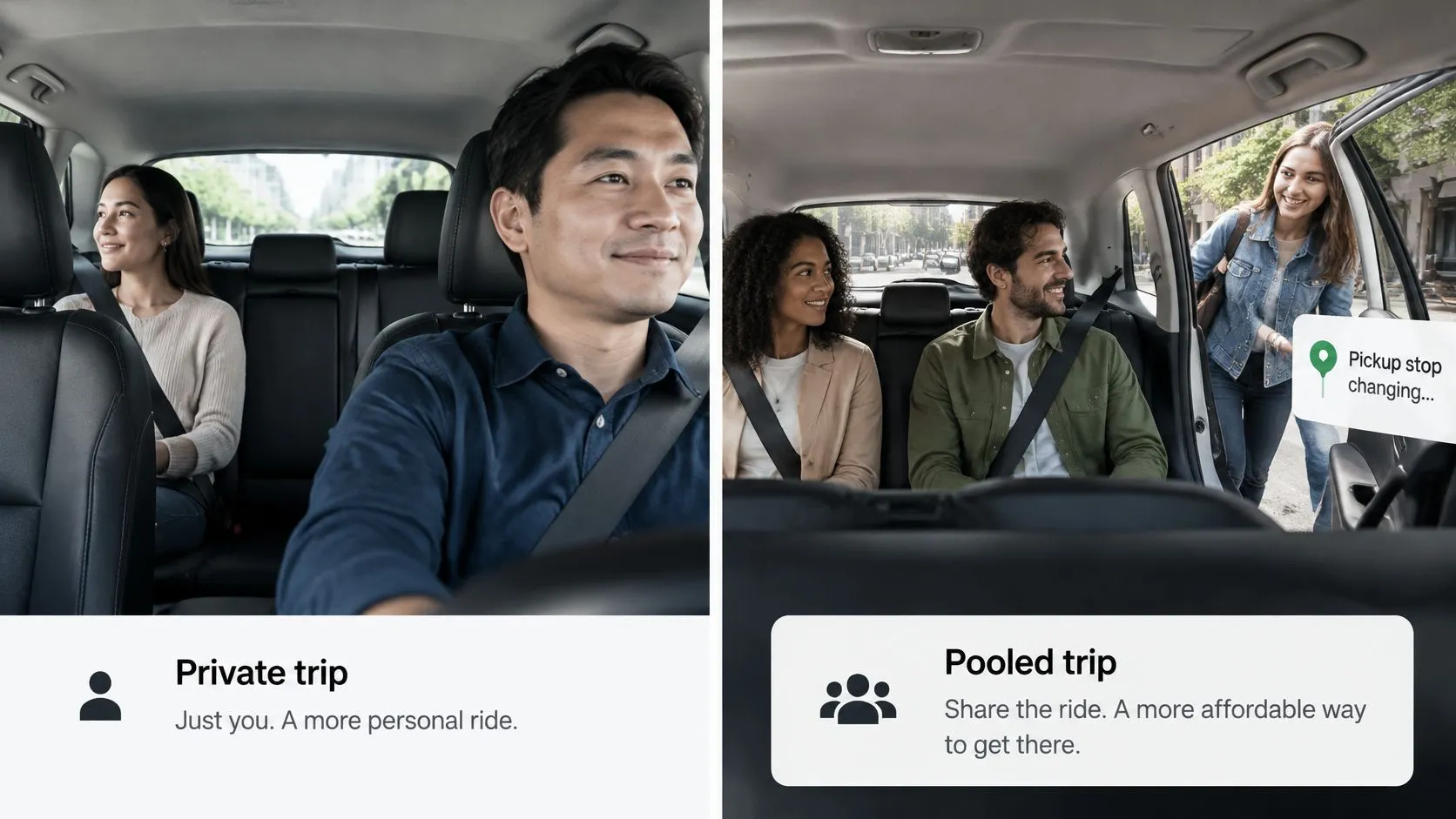
A private hailed trip is one rider, one driver, one route, one ending. A pooled trip is a sequence. You get in, someone else gets in, the driver reroutes, someone gets out, and the price you agreed to may not describe the journey you finish. Both are ordinary. They don’t carry the same exposure, because the number of people who can influence the trip is different.
What changes when the car fills up
Every added passenger is an unknown. Not a threat by default, but a person you didn’t screen and can’t predict, sharing a small enclosed space with you for the length of their leg of the journey. At 2pm that’s an inconvenience. At midnight, travelling alone, it’s a decision worth making deliberately.
The route also stops being fixed. A pooled trip can run longer than the solo quote shown at booking, and the detour arrives after you’ve already committed to the car. In the RideAustin trip analysis published in research on deadheading and shared mobility, an analysis of approximately 282,037 trips found time efficiency of 42.8% to 58.4%, which is a reminder of how much of a vehicle’s working life isn’t spent moving a passenger toward their destination. The study’s practical conclusion for safety tooling is direct: pooled trips involve dynamic passenger additions, route deviations and longer journey times than the quoted solo trip, so continuous route visibility and clear trip-state communication do more for a rider than the pickup and destination they saw at booking.
Matching the car before you get in
Verify before the door opens. Compare the plate number, the driver’s photo and the name in the app against the car in front of you, and don’t board a mismatch, even if the driver insists. Ask the driver who they’re collecting rather than offering your own name, since a genuine driver has your name and an impersonator usually doesn’t.
Monitoring is the other half. A trip that streams its route to people you chose gives a watcher something to act on. When you start a trip in 3rd-i, the people you picked, or anyone you send your link to, can watch the route and video. You can text a Safety Agent mid-trip if something feels wrong, and 3rd-i Trips sends alert notifications if you end the trip early or arrive at the desired location. For a wider look at what incident data shows, is rideshare safe works through the record.
After a collision, the questions shift to coverage and liability, especially when a pooled car is carrying passengers who weren’t on the original booking. Insurance coverage after a rideshare crash sets out how those claims are structured, which is worth knowing before you need it.
Who Carries the Hidden Costs
A fare shows what the passenger pays, not the full cost of providing the ride. Comparing ride hailing with ride sharing by price and speed alone can miss unpaid waiting, vehicle wear and the physical risks drivers absorb. The key difference is who else is in the car and who bears costs that the fare does not show.
Estimates of driver earnings vary with what they count. A 2025 report on Oregon independent contractors and employees estimates typical rideshare earnings at $22 per hour and cites UC Berkeley research estimating California median earnings at about $5.97 an hour without tips and $7.63 with tips, after accounting for waiting time and employment-equivalent costs. The difference reflects two ways of measuring work: one focuses on time spent earning through the app, while the other includes hours between trips and costs associated with employment.
Two estimates, one disagreement
Those accounting choices change how a low fare looks. If waiting time is excluded, a driver held through a long match window may appear to earn more per hour than when the unpaid hold is counted. Pooling can therefore lower the passenger’s price while leaving some of the time cost with the driver.
A 2025 transport study summarized in the report found that more than two-thirds of U.S. ride-hailing drivers had experienced violence or abuse on the job, with verbal harassment the most common form. That finding puts safety costs on both sides of the ride: passengers face risks during travel, while drivers also encounter risks in their work.
For a closer look at expenses deducted from gross earnings, see this rideshare driver expense breakdown. Vehicle costs help explain why gross pay and take-home earnings are not interchangeable.
The question worth asking: how do pooling, dynamic pricing, platform algorithms and passenger behaviour distribute financial and physical risk between the rider in the back seat and the driver in the front?
There is no single figure that resolves the comparison. A private ride and a pooled trip are priced under different conditions, and the lower fare does not show who absorbs the waiting, operating expenses or risks behind it. For riders, the trade-off is a lower price against less control over the trip; for drivers, it is how much unpaid time and operating cost remains outside the fare.
Which Option Fits Your Situation
The decision rule fits in one line. Choose private ride hailing when urgency, privacy or arrival-time reliability dominate, and choose a pooled trip when the fare saving matters, the detour is tolerable and your route is a busy one.
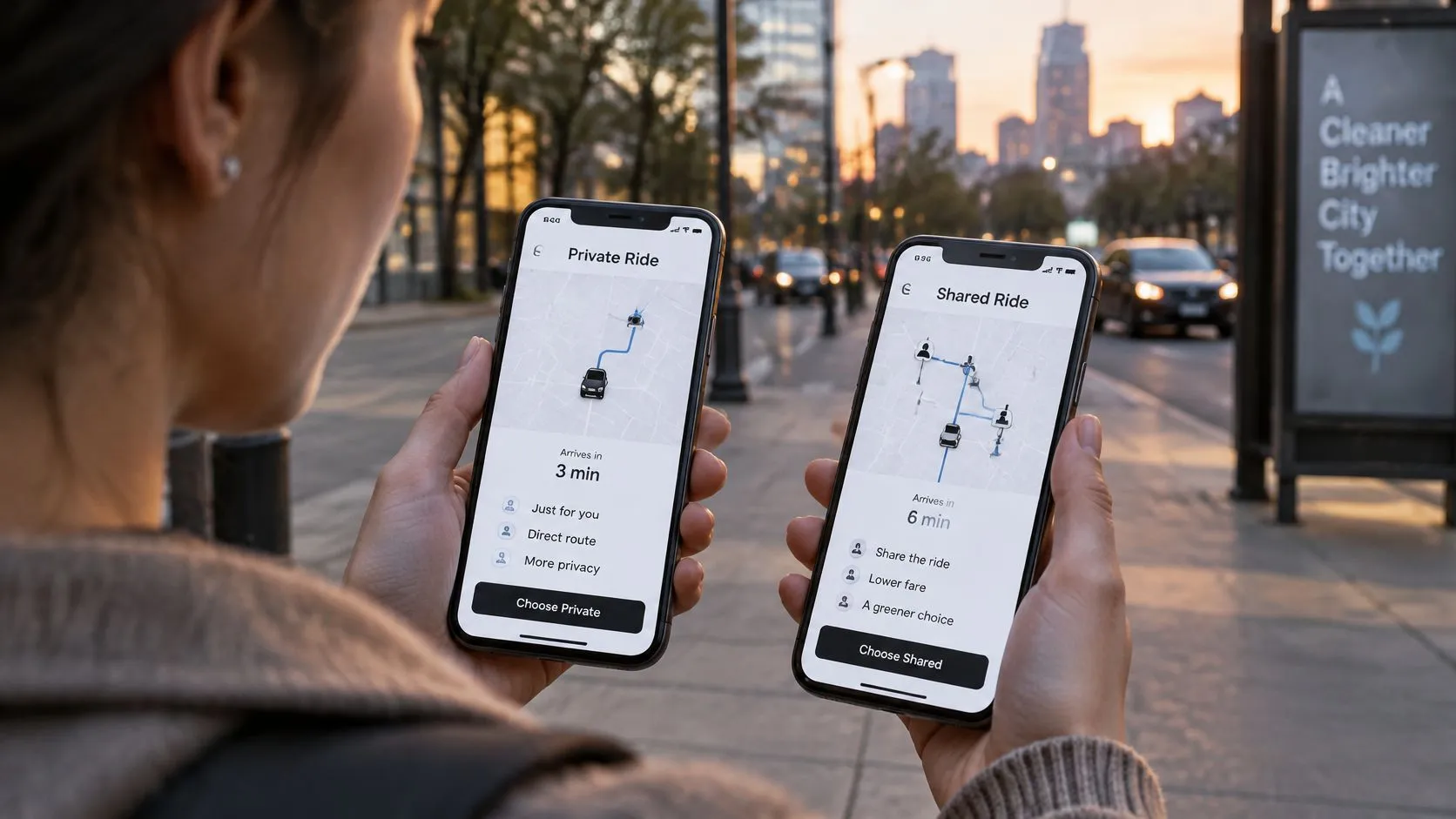
Applying that rule takes about ten seconds once you know which constraint is binding.
| Situation | Better fit | Why |
|---|---|---|
| Late-night trip alone | Ride hailing | One driver, a direct route and fewer unknown people in the car |
| Group of friends going the same way | Either, check the pooling rules | A shared trip can cut cost when detours are short |
| Time-critical airport or medical trip | Ride hailing | Fewer stops and a more predictable arrival |
| Flexible commute on a fixed route | Ride sharing | Pooling works best with dense, aligned demand |
| Student travelling on campus | Ride hailing with live tracking | Trusted watchers can see the route and escalate |
| Budget-first trip with time to spare | Ride sharing | Lower fare when detour and wait are acceptable |
The factor that usually decides it
Time flexibility outweighs price in almost every close call. A firm deadline, a flight, a hospital appointment, a shift start, converts a pooled trip’s small saving into a real risk. A trip with twenty spare minutes converts the same detour into a reasonable trade.
For readers weighing late-night exposure specifically, solo female travel safety tips covers the practical habits that apply before and during the journey, whether the car is pooled or private.
If you’d rather see the comparison worked through aloud, this walkthrough covers the same ground.
Confirm the Trip Type Before You Book
Five checks, in order, before you tap confirm.
- Identify the product. Read whether the booking is a private trip or an option that may pool other passengers. A shared icon and a private icon can sit two centimetres apart in the same menu.
- Ask what can change after booking. Whether passengers can be added mid-trip, and how a route change appears on screen, tells you how much of the journey is still negotiable after you’ve committed.
- Weigh fare against duration. Compare the pooled quote with the expected trip time, not just with the private quote. A cheaper ride that arrives late isn’t cheaper if the deadline was real.
- Share the route before you leave. Send the trip to someone who will look at it, rather than to a group chat that scrolls past.
- Set your cancellation threshold in advance. Decide now which conditions, an unexpected extra pickup, a driver who doesn’t match the app, a route that heads the wrong way, justify ending the ride and contacting a safety service.
Our app provides a real-time GPS feed showing your current position and recent route, so a watcher can follow the trip as it happens rather than reconstructing it afterwards. One caveat worth stating plainly: SOS and dispatch run through RapidSOS and are currently available only in the United States, and may not be available in all areas or at all times. 3rd-i isn’t a substitute for calling emergency services.
For a fuller set of habits that apply to any trip, rideshare safety tips is a sensible next read. Then confirm three things for your own city: the trip type the app is selling you, what monitoring your chosen tool provides, and whether its emergency features cover where you’re travelling.
3rd-i streams the ride and the route to the people you choose, from the moment you get in until you’re back through the door, with a Safety Agent you can text mid-trip when something feels off. That matters most on the pooled trips this comparison turns on, where extra passengers and shifting routes make live visibility more useful than a fixed pickup pin. Visit 3rd-i to see how a watched trip works before your next late ride home.