
Key Fob Tracker How It Works Uses and Limits
You’re leaving for work, a late class, or a walk home when your car keys disappear. They aren’t gone in any dramatic sense. They’re probably under a coat, inside a bag, or still sitting in the vehicle. Yet those missing minutes can make a routine departure feel unsafe and surprisingly stressful.
That’s why people search for a key fob tracker. They want a small device that can help locate a misplaced car key, but many also expect something closer to a GPS tracker that can follow a vehicle wherever it goes. Those are different jobs. A tracker can be excellent at finding a fob nearby, while being unable to provide a live location once the fob moves beyond its communication range.
This guide separates the useful reality from the marketing shortcut. You’ll learn how Bluetooth, GPS, and Ultra Wideband differ, where a key fob tracker helps at home or work, why range claims can mislead you, and how battery replacement and privacy fit into ownership. Most of all, you’ll see how to pair a tracker’s last-known-location capability with live human monitoring when the concern is a person walking alone, using a rideshare, or working an isolated shift.
Table of Contents
- What a Key Fob Tracker Actually Is and How It Helps
- How Key Fob Trackers Work Across Bluetooth GPS and Ultra Wideband
- Everyday Uses for Key Fob Trackers at Home on Campus and at Work
- Limitations and Common Misconceptions About Tracking Range
- Privacy Security and Battery Realities You Should Know
- Building a Safer Workflow by Pairing Trackers With Live Safety Support
What a Key Fob Tracker Actually Is and How It Helps
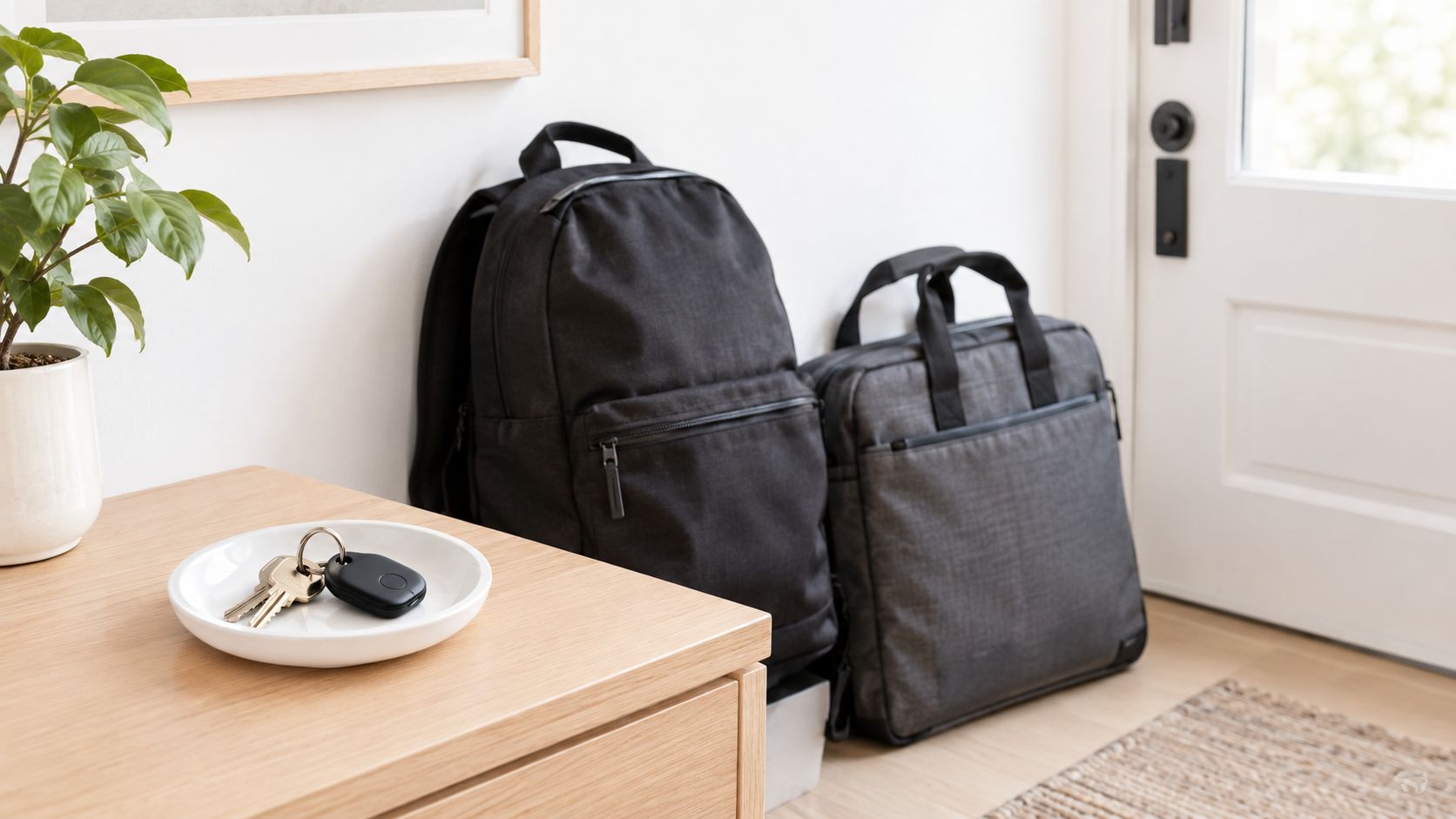
A key fob tracker is a small add-on device attached to your keys. It sends or responds to a radio signal, and a compatible phone, reader, or network helps you locate it. The tracker usually isn’t part of the vehicle’s factory key fob, and it doesn’t automatically know where your car is.
Think of it as a tiny lighthouse. The tracker emits a beacon, while your phone acts as the listener. If the phone can hear the beacon, its app can show that the fob is nearby and may help you move toward it. If the phone can’t hear it, the app may show the last place where the two devices were connected.
Key concept: A key fob tracker helps you locate the object carrying the tracker. It doesn’t automatically provide live, worldwide tracking of the car or the person carrying the keys.
The distinction matters in everyday situations. If you’ve left your keys beneath a sofa cushion, a nearby Bluetooth tracker can make the search faster. If someone drives away with the keys, a basic Bluetooth model generally won’t create a continuous movement trail. The phone, network, subscription model, and tracker ecosystem all determine what information remains available.
Form factor also affects usefulness. A tracker needs to stay attached to the key ring without making the fob awkward to carry. A loud alert can help in a quiet room, while a slimmer device may work better inside a wallet or work badge holder. The right choice depends on whether your priority is a quick household search, shared family belongings, fleet control, or a wider safety process.
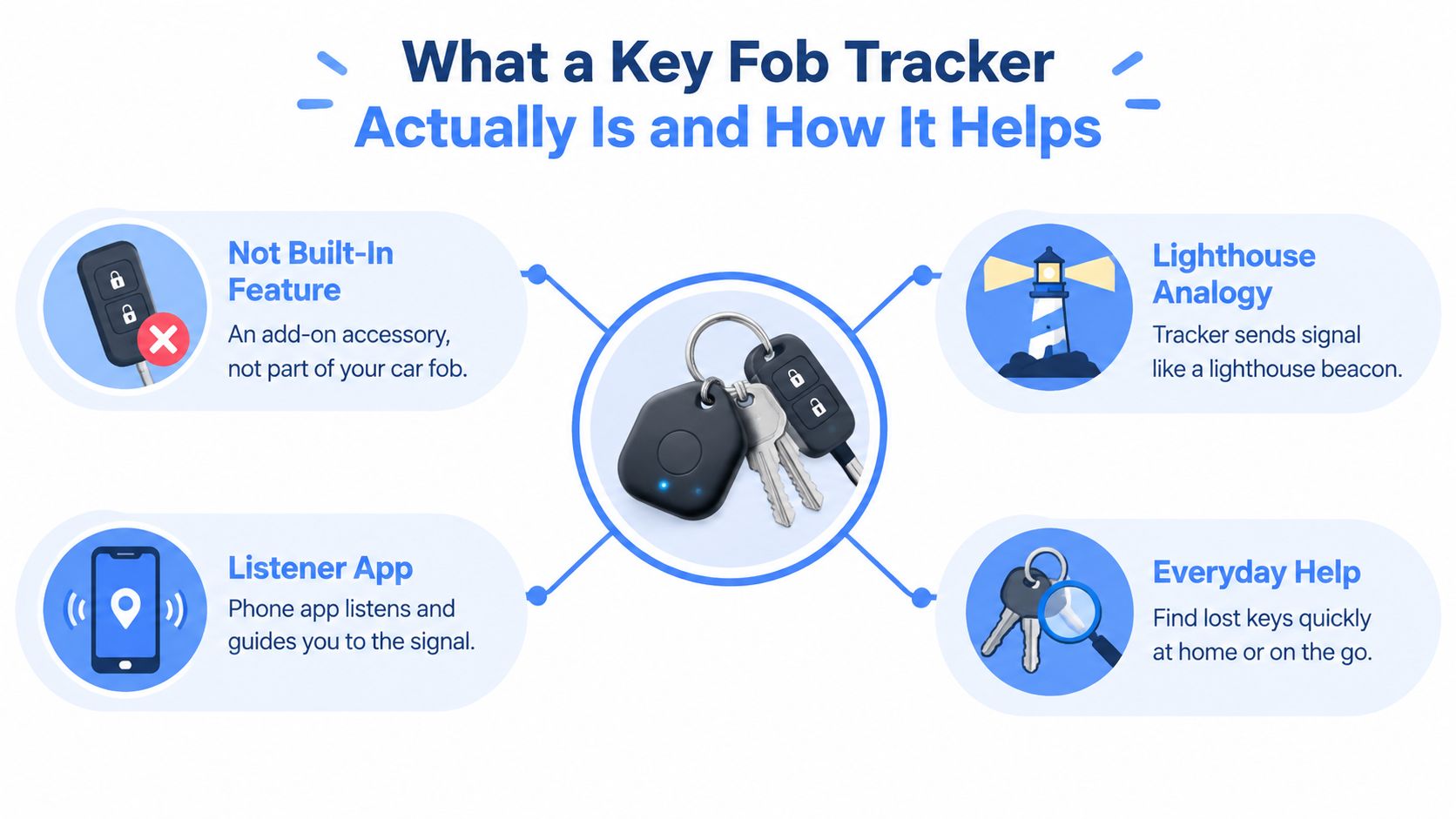
A useful setup has three parts:
- The beacon: The tag sends a signal or identifies itself to a reader.
- The listener: A phone or dedicated receiver detects that signal.
- The ecosystem: An app or connected service turns detection into a map, alert, sound, or recovery record.
That simple model prevents a common buying mistake. A device may have impressive radio hardware, but it still needs a receiver close enough, a compatible app, and enough battery power to do anything practical.
How Key Fob Trackers Work Across Bluetooth GPS and Ultra Wideband
You are looking for keys under a sofa cushion. A short-range Bluetooth signal can guide your phone toward them. If the keys were carried into another neighbourhood, that same tracker may offer no live route. The word “tracking” covers several different radio systems, and each answers a different location question.
Bluetooth Low Energy is the usual short-range method. It generally operates in the 2.4 GHz band. Published specifications for BLE key-fob devices describe ranges of up to 90 metres at 0 dBm, up to 200 metres at 4 dBm, and about 100 metres at 4 dBm, depending on the device and its settings (KeyBox Systems technical specifications). Those figures describe radio capability in test conditions. Walls, vehicles, interference, and the phone’s own receiver can reduce practical detection distance.
GPS follows a different model. The tracker receives satellite signals and calculates an outdoor position. To share that position elsewhere, it also needs a communication path, such as cellular service, plus enough power for both functions. A small Bluetooth key finder usually does not contain this complete system. Its last-known location can help a person begin a search, but it does not create a continuous movement record.
Ultra Wideband is designed for close-range precision. When the tag and phone both support it, the system can estimate distance and direction more precisely than a basic Bluetooth signal-strength reading. Bluetooth may tell you that the fob is nearby. Ultra Wideband can help indicate which side of the room to check.
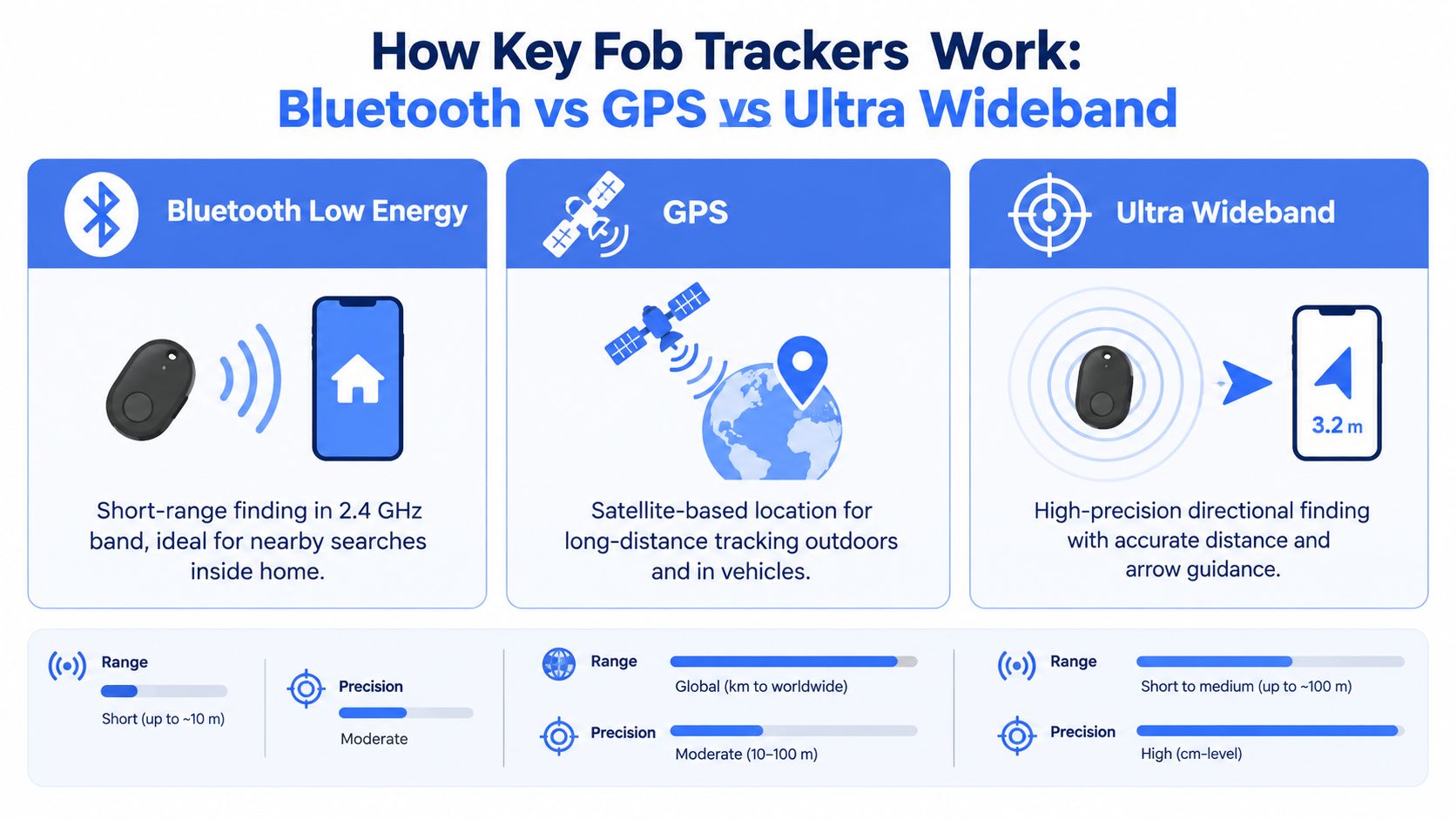
| Technology | Typical Range | Accuracy | Battery Impact | Best For |
|---|---|---|---|---|
| Bluetooth Low Energy | Short range, shaped by walls, interference, power, and protocol settings | Useful for proximity, less exact at a distance | Usually low, especially with infrequent beaconing | Finding keys around a home, office, or nearby vehicle |
| GPS | Long-distance outdoor positioning when the tracker can receive and transmit data | Location-level accuracy outdoors, with environmental limits | Higher because of satellite reception and data transmission | Vehicles and assets that need broader-area location |
| Ultra Wideband | Short-range precision rather than broad coverage | Strong for directional, close-proximity finding | Depends on the tag and phone design | Locating a nearby fob inside a room or building |
Battery demand rises with communication frequency, signal strength, and the amount of processing involved. A small coin cell can support long service when a BLE tag sends brief, occasional beacons. More frequent updates consume power faster, so battery life depends on the device settings and how it is used.
Choose the radio by the question you need answered. Bluetooth helps with nearby discovery, GPS supports broader outdoor location, and Ultra Wideband provides precise final-room guidance. For safety, a Bluetooth tracker’s last-known location works best as a starting point for a live human monitoring workflow, not as a replacement for one.
Everyday Uses for Key Fob Trackers at Home on Campus and at Work
At home, the value is immediate. You hear the phone’s alert and search near the last connection point instead of emptying every drawer. The tracker doesn’t remove the need to look, but it turns an unstructured search into a guided one.
A parent might attach a tracker to a shared set of vehicle keys. If the keys were last detected near the entryway, the next person can check the coat pocket or school bag before assuming they’re locked in the car. If the fob is inside the vehicle, the tracker may help confirm that nearby location, although it won’t open the car or prevent theft.
Families and students
A student leaving a library after dark may use a tracker to find keys in a backpack before walking to a car. That solves an object problem. It doesn’t tell a trusted contact whether the student reached the vehicle safely, whether the route changed, or whether an incident is unfolding.
For those situations, a dedicated campus safety app can provide a separate layer of live route sharing and communication. The tracker helps locate the keys, while the safety workflow keeps selected people informed about the person.
Offices and vehicle fleets
Workplaces face a different challenge when multiple drivers share keys. A tracker can help staff identify a fob’s last detected location, but a fleet still needs clear handover rules, access records, and a process for missing equipment. Guidance on secure fleet assets and keys can help organisations think beyond attaching a tag and address how people control shared vehicle access.
Lone workers and late shifts
A cleaner, security guard, delivery worker, or maintenance employee may carry several keys during an isolated shift. A tracker can reduce time spent searching for a dropped or misplaced fob. It can’t replace a check-in process, an emergency contact, or a trained person who can respond if the worker becomes unreachable.
That boundary is useful rather than disappointing. Use a key fob tracker for object recovery, then use human oversight for personal safety. Treating those as separate jobs makes the whole arrangement easier to test and less likely to fail at the moment you need it.
Limitations and Common Misconceptions About Tracking Range
The most important limitation is simple: a Bluetooth key fob tracker isn’t usually a GPS tracker. Independent guidance places practical Bluetooth key-finder coverage at roughly 25 to 120 metres, depending on walls and interference, while another academic description gives practical Bluetooth range of up to about 10 metres in some implementations (Alibaba Electronics buying guide). These figures differ because device power, receiver quality, radio settings, building materials, and test conditions differ.
Once the fob moves outside the phone’s usable range, the app generally can’t show live movement. It can show the last-known location, meaning the last place where the phone and tracker successfully communicated. That might be enough to tell you the keys were left at the office, but it won’t tell you where they travelled afterward.
Why the same tracker behaves differently
A tracker may work well in an open car park and poorly inside a concrete building. Walls absorb or reflect radio energy, metal can obstruct signals, and other wireless devices can create interference. The phone itself also matters because its antenna and operating system determine how consistently it scans for nearby devices.
This is why “up to” range should be treated as a ceiling under stated conditions, not a guaranteed search radius. A product that claims a longer open-field distance may still perform like a short-range finder in a crowded home or underground garage.
Longer-range radio isn’t the same as live tracking
Active RFID and sub-GHz systems can provide greater raw detection distance than many Bluetooth tags. One 433.92 MHz active RFID key fob is specified at 1 to 100-plus metres, while a related unit reports an average output of 77 dBµV/m at 3 metres and uses a replaceable lithium battery (GAO RFID active tag specifications). Those specifications describe radio performance, not an automatic worldwide location service.
The reader side often determines the result. Antenna design, receiver sensitivity, local interference, enclosure losses, and the building layout all influence whether the system detects the tag. Sub-GHz equipment can benefit from lower path loss and better wall penetration, but the environment still controls the practical outcome.
Practical rule: Ask, “What receives the signal at the place I need to search?” before asking how far the tag can transmit.
If you need a vehicle’s location after it leaves the immediate area, look for a purpose-built connected GPS solution rather than assuming a Bluetooth key fob tracker can provide that coverage.
Privacy Security and Battery Realities You Should Know
A tracker needs care after installation. Many models use coin cells such as CR2032 or CR1616, and product documentation lists advertised battery life from roughly 2 to 3 months up to 1 to 2 years, depending on the model and design (Ekster key tracker user manual). Treat that range as a maintenance reminder, not a promise. Check the battery status in the app where available, record the replacement type in household or fleet instructions, and test the alert after changing the cell.
A flat battery can leave only an old location, like a signpost showing where the keys were last seen, with no useful nearby signal. For hands-on instructions, a DIY car key fob battery guide explains coin-cell replacement. The tracker and vehicle fob may use different batteries and opening methods, so replacing the car key battery does not maintain the separate tracker.
Privacy depends on the ecosystem
Privacy is shaped by the tracker’s app, account settings, and shared-device permissions. Modern trackers commonly use encrypted, anonymised Bluetooth identifiers, but users still need to check who can view the device, who controls the account, and what happens when ownership changes. A last-known location is useful for finding an item, yet it can reveal routines when access is shared carelessly.
Attach the tracker openly, explain who has access, and review permissions when a family member leaves a household or an employee changes role. If a live safety session needs temporary privacy, Ghost mode for temporary location privacy can let a person go off the map during that session. It does not alter the key tracker’s communication or erase the tracker’s own records.
Keyless theft is a separate security problem
A key fob tracker helps locate a misplaced key. It does not automatically protect a vehicle from relay attacks, cloning, or other keyless theft methods. Tracker reported that 92% of vehicles stolen and recovered in 2019 were taken without the owner’s keys, rising to 93% in 2020 (Tracker report via NewsBreak). The National Insurance Crime Bureau recorded 229,339 vehicles stolen between 2016 and 2018 because drivers left keys or fobs inside, an average of 209 thefts per day, with 69,351 occurring in 2018 (NICB data cited by Tracker).
These figures point to two separate precautions: protect the fob from physical loss and wireless misuse, then choose a vehicle security or recovery system when longer-distance protection is needed. A key fob tag is a short-range finder, not an immobiliser or live GPS service. Its last-known location becomes more useful when a person is assigned to monitor alerts, confirm the situation, and contact help when needed.
Building a Safer Workflow by Pairing Trackers With Live Safety Support
A key fob tracker solves a narrow problem well: locating the object attached to it. Personal safety requires a wider workflow because a person can be in danger even when the keys are exactly where they should be.
Start with the moment that causes concern. Before a late walk, a rideshare, or a lone shift, attach the keys securely, check that the tracker has battery power, and tell a trusted contact when the journey begins. If the person needs more than a static check-in, use a system that shares live context rather than relying on a key tag to provide it.
Match each tool to its job
A practical arrangement might look like this:
- Lost keys at home: Use the tracker’s nearby alert and last-known location.
- A late walk or commute: Share the live route with selected contacts and keep a one-tap emergency option available.
- A lone-working shift: Set an agreed check-in time and define who responds if the worker misses it.
- A vehicle recovery concern: Use a connected vehicle security or recovery service designed for longer-distance location.
- A privacy-sensitive journey: Confirm who can view the route and use privacy controls when appropriate.
The 3rd-i app provides live video, audio, and location sharing with selected contacts and trained Safety Agents. Its monitoring workflow can support communication and escalation through RapidSOS, while the 24-hour personal safety app describes the always-available structure for people who need support beyond a nearby key search.
Test the process before you depend on it
Run a short practice with the actual phone, tracker, car keys, and contacts. Walk from one room to another, test the alert, confirm the last-known location, and check who receives a shared route. Then test the human response, including what happens if the person doesn’t answer a nudge.
Safety principle: A device gives information. A workflow assigns responsibility for acting on it.
Review the setup when a phone changes, a battery warning appears, a family member loses account access, or a workplace changes its shift pattern. Keep emergency instructions brief enough to follow under stress. If the problem is a missing object, use the tracker. If the problem is an unobserved person, add live human oversight.
3rd-i offers live video, audio, and route sharing with trusted contacts and trained Safety Agents, with emergency escalation through RapidSOS when needed. Visit 3rd-i to see how its live safety workflow can complement a key fob tracker during late walks, rideshares, and lone-working routines.