
BE SAFE Acronym: What It Means and How to Apply It
You’re walking from the train station to your car after dark, headphones on, phone open to a familiar route. You’ve taken the same path before, so your feet move on autopilot while your attention drifts toward the next message or the car waiting ahead.
That routine feels ordinary, but ordinary routines can leave gaps. A short safety mnemonic gives you something practical to recall when you’re tired, distracted, alone, or suddenly unsure about what’s happening around you.
Table of Contents
- Why a Simple Acronym Matters for Personal Safety
- Breaking Down Each Letter of the BE SAFE Acronym
- Where BE SAFE Originates and How It Is Used Today
- Applying BE SAFE to a Late-Night Walk and a Rideshare
- Pairing the Acronym with 3rd-i Features Step by Step
- Why Live Monitoring Beats a Verbal Reminder Alone
- A Quick BE SAFE Checklist and Common Questions
Why a Simple Acronym Matters for Personal Safety
“Be safe” isn’t a standardized acronym in mainstream reference sources. Dictionaries generally treat it as a plain warning or wish for safety, closely related to the older expression “better safe than sorry,” which means taking care now is wiser than dealing with problems later. Merriam-Webster’s explanation of “better safe than sorry” supports that everyday interpretation rather than a single official expansion of the phrase.
That distinction matters. You may find several versions of the BE SAFE acronym, especially in workplace training, electrical safety, roadside response, and personal-safety guides. The letters don’t carry one universal meaning, so always check the version being taught. In this article, BE SAFE is a personal-safety framework for Behavior, Environment, Situational awareness, Assistance, Feedback, and Escape planning.
Why recall matters under pressure
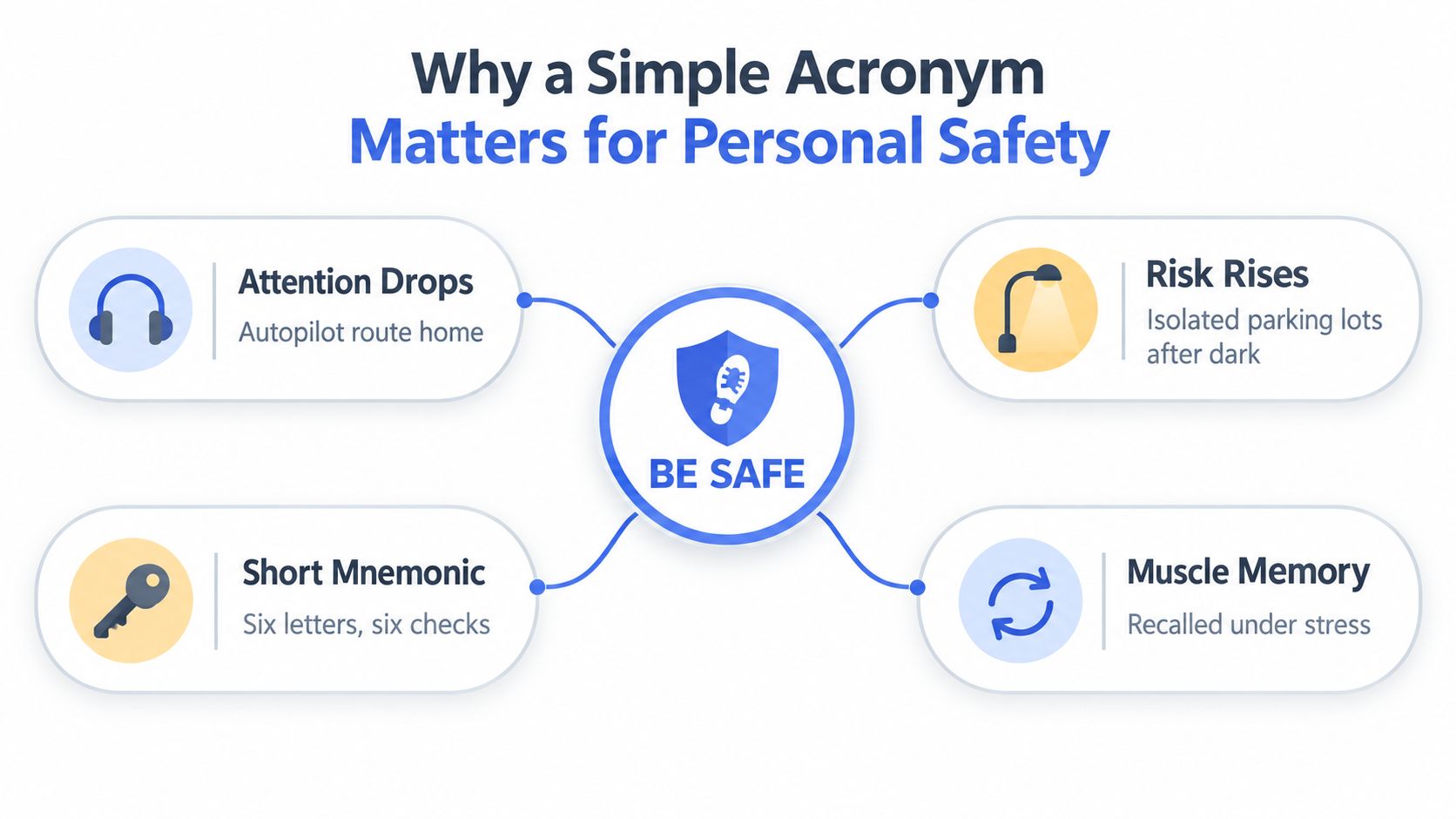
Stress changes how people process information. A long lecture about route planning, phone use, exits, check-ins, and bystanders is difficult to retrieve in the moment. Six short prompts are easier to rehearse and turn into a quick scan of your surroundings.
Use the mnemonic before and during a journey:
- Before moving, choose a route, identify safer alternatives, and decide who’ll know your plan.
- While moving, keep your attention available and notice changes in people, lighting, traffic, and direction.
- When something feels wrong, treat that feeling as useful information, not an inconvenience.
The same principle applies to digital privacy. Sharing your location with a trusted contact can help, but you should also limit unnecessary exposure of personal details. A practical guide to keeping your data safe online can complement physical-safety habits, especially when apps, rideshares, and social platforms reveal parts of your routine.
This framework isn’t a substitute for emergency services or judgment. It’s a compact prompt that helps you build a repeatable habit, then connect that habit to tools that can provide contact, context, and escalation when a verbal reminder isn’t enough.
Breaking Down Each Letter of the BE SAFE Acronym
The version below uses each letter as a question you can answer quickly. You don’t need to recite it aloud. Run through it before leaving, then repeat the relevant checks if the situation changes.
| Letter | Meaning | Everyday Example |
|---|---|---|
| B | Behavior | Walk with your eyes up, keep your phone tucked away, and hold your keys where you can reach them. At an ATM, finish your transaction before checking messages. |
| E | Environment | Choose visible, populated, well-lit routes. Face traffic where appropriate, avoid isolated shortcuts, and notice open businesses or staffed buildings. |
| S | Situational awareness | Track exits, nearby people, vehicles, and unusual changes. If someone appears to match your pace for several blocks, cross the street or enter a public place to test the situation safely. |
| A | Assistance | Arrange a check-in partner, share a trip, or walk with someone when the route or circumstances warrant it. For a rideshare, send the trip details and vehicle information to a trusted person. |
| F | Feedback | Treat discomfort as a signal. You can leave a location, call someone, change direction, or tell a driver to stop at a safer place without waiting for proof that something is wrong. |
| E | Escape planning | Know where you’ll go if the route stops feeling safe. A staffed shop, hotel lobby, transport desk, or pharmacy may give you light, people, and a way to request help. |
Turning each letter into a small action
Behavior starts with availability. Keep at least some attention on the environment instead of burying both ears in music or staring at a screen.
Environment is about choosing conditions, not blaming yourself for another person’s actions. A brighter route with more people may take longer, but it can give you more options if plans change.
Situational awareness doesn’t mean assuming everyone is dangerous. It means noticing enough detail to recognize a deviation, such as a vehicle circling, a driver taking an unexpected route, or a person following your turns.
Assistance creates shared awareness. A friend who knows your destination can notice a missed check-in, while a buddy can provide practical support before a concern becomes an emergency.
Feedback gives you permission to act early. You don’t need to justify every precaution to yourself or anyone else.
Escape planning keeps you from improvising at the worst moment. Identify the next safe door, public area, or staffed location before you need it.
The acronym only becomes useful through rehearsal. Say the letters before a late walk, use them at the start of a rideshare, and practice the response you’ll take if one answer changes.
Where BE SAFE Originates and How It Is Used Today
BE SAFE has no single fixed technical expansion. Its broad use reflects a wider safety-training practice, where organizations turn instructions into short letter-based prompts that workers can remember during a task. One published safety-slogan collection contains 500+ entries, illustrating how enduring and varied mnemonic safety messaging has become.
In electrical safety training, one BE SAFE version highlights burns, electrocution, shock, arc flash or arc blast, fire, and explosions. The value is practical. A worker can use the phrase as a pre-task hazard scan, then apply controls such as de-energizing equipment, observing approach boundaries, and selecting appropriate protective equipment before approaching energized systems. An electrical-safety explanation of the BE SAFE hazard mnemonic describes that hazard-focused use.
Roadside response uses another adaptation. In that context, BE SAFE can mean Safety first, Alert authorities, Fact collection, and Exchange information. The sequence prioritizes securing the scene and contacting authorities before collecting details and exchanging identifiers. Grange Insurance’s accident-response guidance shows how a fixed sequence can reduce omissions during a stressful incident.
What transfers to personal safety
The hazards change outside the workplace. Electrical training focuses on energized equipment and secondary hazards. Roadside procedures focus on traffic, scene control, and evidence. A person walking alone faces different questions, such as whether the route is isolated, whether a vehicle or person is behaving unusually, and where help is available.
The underlying decision pattern remains similar:
- Recognize the conditions before exposure increases.
- Create distance or control where possible.
- Contact assistance instead of handling everything alone.
- Preserve options by knowing where to move next.
That’s why adapting BE SAFE can work for solo travel and lone work, provided each letter leads to a behavior. A mnemonic that stays on a poster won’t monitor a route, record context, or contact a guardian. A connected safety session can support those actions while the user keeps moving.
Applying BE SAFE to a Late-Night Walk and a Rideshare
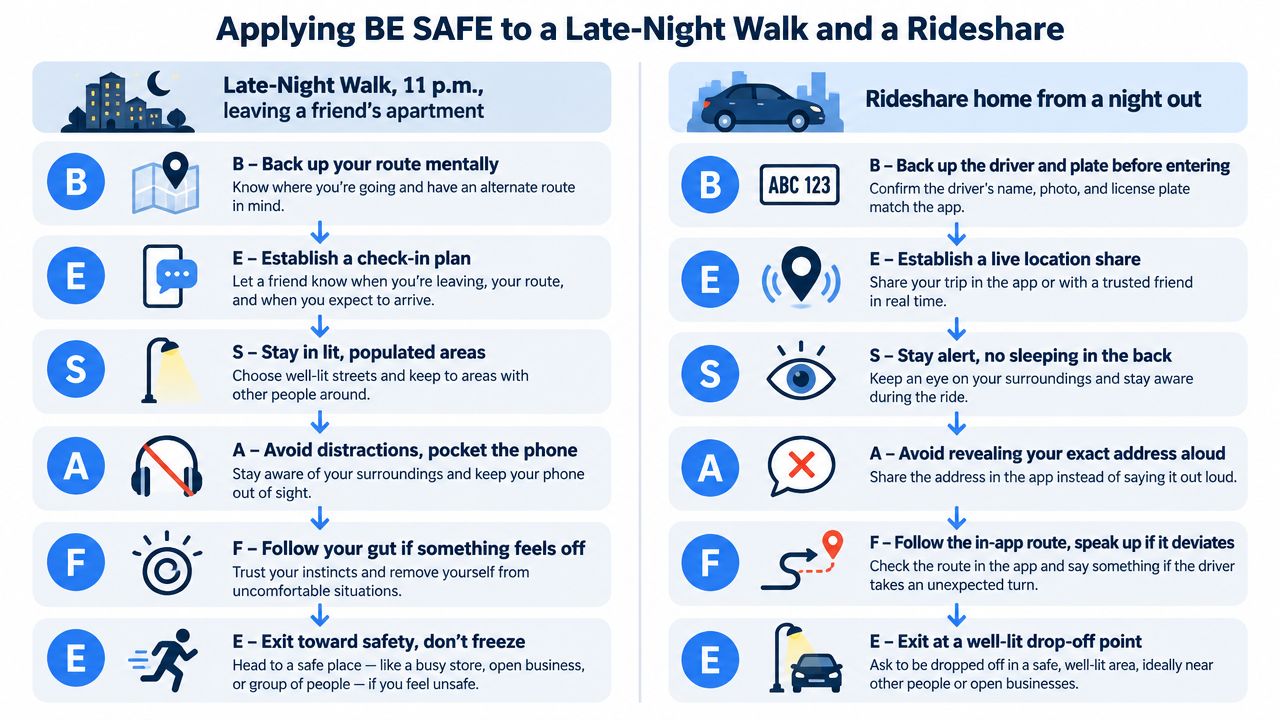
Consider a person leaving a friend’s apartment late at night. She checks the route before stepping outside, keeps her phone accessible without holding it in front of her face, and avoids treating the familiar journey as automatic.
B, Behavior, starts with purposeful movement. She keeps her eyes up, stores her phone after checking the route, and keeps her keys in the same reachable pocket. She doesn’t need to look frightened, but she does need enough attention to notice what’s around her.
E, Environment, changes when she spots a dark stretch between buildings. Instead of taking the shortest path, she identifies a lit route toward a busier road. S, Situational awareness, means she notices reflective windows, parked vehicles, open storefronts, and whether anyone appears to be following her turns.
A, Assistance, begins before the walk. She shares her destination or arranges a check-in with a trusted person. F, Feedback, becomes relevant when the street grows quieter than expected and her instincts tell her to change direction. She doesn’t argue with that signal. She crosses toward a staffed, well-lit business.
E, Escape planning, gives her a destination rather than a vague hope of getting away. A pharmacy, hotel lobby, transport office, or open petrol station can provide people, lighting, and a place to call for help.
Applying the same pattern to a rideshare
A rideshare creates a different set of checks. Before entering, the passenger verifies the driver’s name, vehicle, and plate against the app. That’s Behavior and Environment working together, because the passenger confirms both the information and the pickup setting.
The passenger then shares the trip with a trusted contact, watches the route, and avoids disclosing unnecessary personal details aloud. If the vehicle deviates from the expected route, Feedback means speaking up and asking for clarification or requesting a stop at a safer, public location.
If you’re concerned about private conversations being overheard in public or in a vehicle, review practical guidance on how to stop eavesdropping today. Privacy is one part of personal safety, and limiting sensitive details can reduce unnecessary exposure.
For more route-specific guidance, use this resource on staying safe while walking alone at night. The acronym works best when you mentally rehearse it before the journey, not when you’re already reacting to a problem.
Pairing the Acronym with 3rd-i Features Step by Step
A mnemonic tells you what to remember. A safety app can turn that reminder into an action shared with other people. For example, 3rd-i offers live video, audio, and location streaming to selected contacts and trained Safety Agents, with emergency escalation through RapidSOS. The app isn’t a replacement for emergency services, but it can add live context to a safety session.
| BE SAFE Letter | Meaning | Matching 3rd-i Feature | How It Activates |
|---|---|---|---|
| B | Begin with a prepared route and visible support | Go Live | Start a session so selected contacts can view the route and live stream while you travel. |
| E | Examine the route and surrounding conditions | Safety Map overlay | Review available safety information before choosing where to walk or stop. |
| S | Stay aware and reduce avoidable exposure | Emergency Entry Pin | Store or use an entry detail that can guide responders to the closest entrance during an emergency. |
| A | Arrange assistance before the journey | Squad viewing and Nudges | Let selected contacts view the session and send short prompts or check-in requests. |
| F | Follow changes and respond to concerns | Movement detection prompts | Receive prompts when a session includes a stop or silence pattern that needs attention. |
| E | Escalate and move toward safety | Shake to Alert and SOS | Trigger an alert through a discreet gesture or contact a Safety Agent for escalation. |
Make the tap follow the thought
At the start of a late walk, B can mean beginning Go Live before leaving the station. E can mean checking the Safety Map and choosing a route with better options. During a rideshare, S can prompt you to remain attentive to the trip while keeping Emergency Entry Pin information available if responders need to reach you.
A becomes a shared session rather than a message sent into a chat thread. Selected contacts can see the route and watcher count, while one-tap Nudges such as “You good?” reduce the need to type while moving.
For lone workers, F can connect the mental check to movement detection prompts within set hours. If you stop unexpectedly, a prompt can create an opportunity to respond. E becomes the escalation step, using SOS or Shake to Alert when a situation requires more than a reassurance message. The service also supports Safety Agents who can call or chat and, when appropriate, escalate through RapidSOS.
For a broader explanation of real-time safety monitoring, focus on the operating model rather than the acronym alone. The practical question is always the same: what action will happen if you don’t respond?
Why Live Monitoring Beats a Verbal Reminder Alone
A verbal reminder depends on attention. Fatigue, fear, illness, alcohol, poor signal, or a rapidly changing situation can make it difficult to remember every step or explain what’s happening.
Live monitoring adds a different layer:
- Attention versus automation: You still make decisions, but a live session can share location and video without requiring constant messages.
- Memory versus current context: A trusted contact or Safety Agent can see what’s unfolding instead of relying only on a delayed description.
- Solo judgment versus shared oversight: Another person can notice a missed check-in, route change, or stopped movement and decide whether to contact you.
The limitation is important. Monitoring needs a charged device, a usable connection, and a consenting guardian or monitoring arrangement. It can’t remove environmental risks, guarantee a response, or replace local emergency services and sensible route choices.
A layered approach is stronger than either option alone. BE SAFE prompts the habit, while a live safety session can preserve context and support escalation when the user can’t safely keep checking in. Risk-based systems can help explain how monitoring decisions change according to context, as outlined in what risk-based monitoring means.
A Quick BE SAFE Checklist and Common Questions
Save this compact version in your notes or rehearse it before a late walk, rideshare, commute, or lone-work shift:
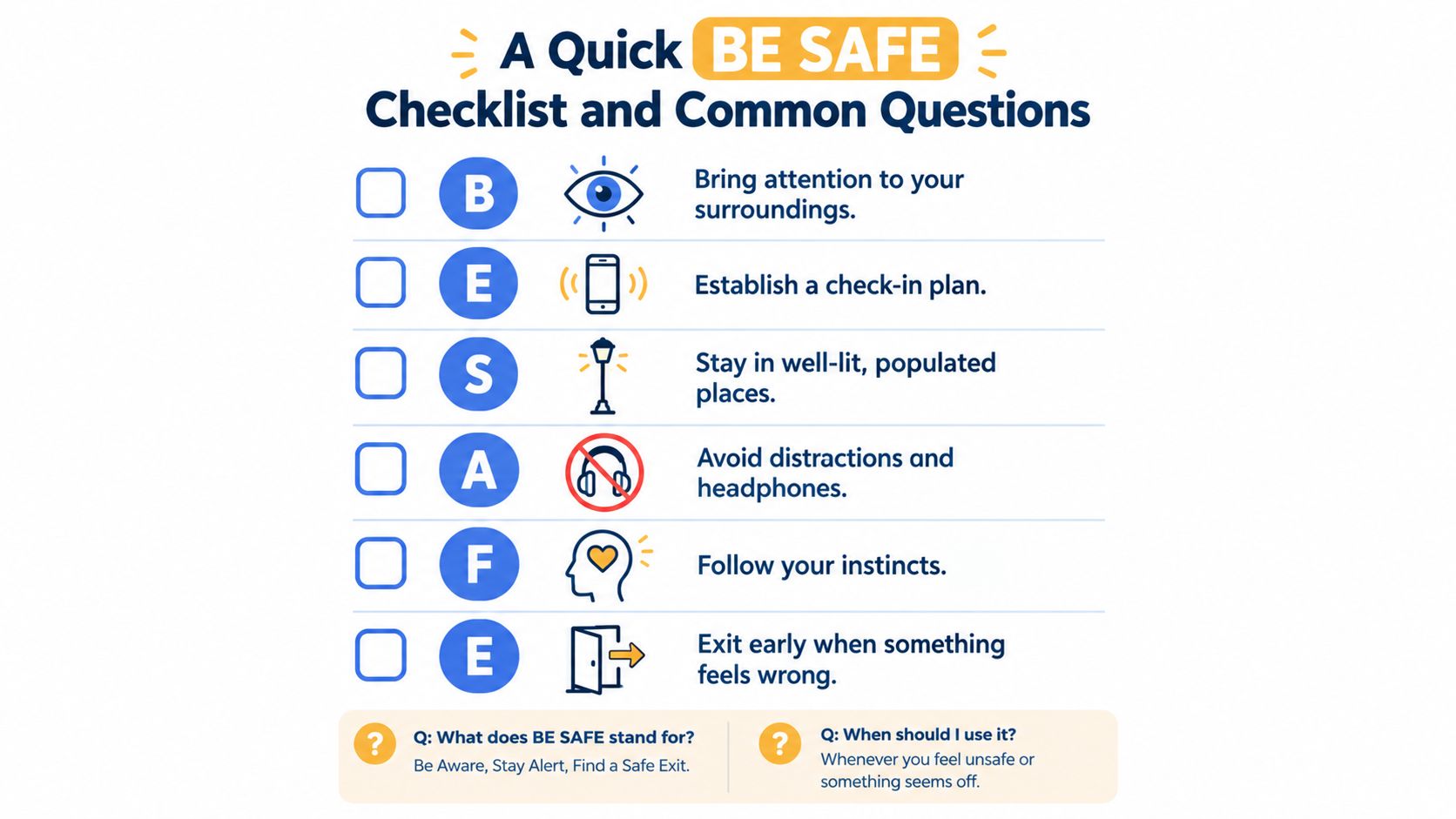
- B, Bring attention: Put the phone away when you’re moving and keep your eyes and ears available.
- E, Establish a plan: Choose a route, identify a safer alternative, and arrange a check-in.
- S, Stay visible: Prefer well-lit, populated places and notice exits, open businesses, and transport points.
- A, Alert support: Share your location or trip details and tell someone when circumstances change.
- F, Follow your instincts: If a person, vehicle, route, or setting feels wrong, change direction or seek help early.
- E, Exit and escalate: Move toward a safe public place and use the available alert function when you need assistance.
Common questions
Does BE SAFE apply during the day?
Yes. Daylight may improve visibility, but distractions, unfamiliar routes, rideshares, and lone-work conditions still create decisions worth planning. Use the checklist whenever you’re alone, entering an unfamiliar setting, or responsible for someone else’s safe arrival.
Is this different from ordinary situational awareness?
Situational awareness is one part of the framework. BE SAFE also prompts preparation, assistance, feedback, and an exit decision, so it turns a broad idea into actions you can rehearse.
What if my check-in contact doesn’t respond?
Don’t wait indefinitely for one person if you’re uncomfortable. Contact another trusted person, move to a staffed public place, call local emergency services when there’s immediate danger, or use an available Safety Agent and alert feature if your safety plan includes them.
3rd-i offers live video, audio, and location sharing, trusted-contact viewing, one-tap Nudges, SOS access, Safety Agent monitoring, and emergency escalation through RapidSOS for situations such as late walks, rideshares, and lone work. Turn the BE SAFE checklist into a live safety routine by visiting 3rd-i and choosing the setup that fits your next journey.