
Dog at Large: What the Law Means and How to Respond
A dog at large is generally a dog off its owner’s property and not under the owner’s reasonable physical control, and the exact rule depends on your local ordinance. You’re walking to your car, pushing a stroller, or bringing in a delivery when a dog with no leash and no person nearby rounds the corner. You don’t know if it’s friendly, lost, hurt, or about to run into traffic, and you have a few seconds to decide what to do.
That uncertainty is why the legal label matters less in the first moment than two practical questions. Is anyone at risk right now, and can you describe where the dog is and where it’s heading? A loose dog is usually both a time-sensitive lost-pet incident and a safety incident. Treat it that way. Stay calm, create distance, observe from a safe spot, and route a clear report to the right local contact.
Table of Contents
- What Dog at Large Means in Plain Terms
- How Local Ordinances Define and Penalize Loose Dogs
- How to Respond Safely at the Scene
- Who to Call Based on What the Dog Is Doing
- What to Record for a Useful Report
- What to Do After a Bite
- Owner Responsibilities and Liability Exposure
- Prevention Steps and Sample Municipal Language
What Dog at Large Means in Plain Terms
A dog at large is a dog that isn’t confined to its owner’s property and isn’t under a person’s physical control in public. The wording changes by city and state, but most ordinances test the same three elements. You’re looking at location, control, and the owner’s ability to restrain the dog.
The Three Elements Most Codes Test
- Location: Is the dog off the owner’s premises or in a public place, such as a sidewalk, park, road, or neighbor’s yard?
- Control: Is there a leash, a competent handler, or a secure fence restraining the dog, or is that control missing?
- Owner status: Is the owner absent, too far away to intervene, or unable to stop the dog from approaching people, animals, or traffic?
A gate left open provides a good comparison. The rule targets the gap in control, not the dog’s breed or temperament. A gentle, well-trained dog trotting loose down a street can still meet the definition, while a reactive dog held on a short leash by a handler who can restrain it may not. That distinction confuses many readers, because “at large” sounds like it means dangerous. It doesn’t.
A dog doesn’t have to bite, chase, or act aggressively to be at large. Being uncontrolled in the wrong place is enough under many codes.
A momentary slip is also different from a pattern, even when both meet the definition. Say a dog darts past a child opening a front door and the owner retrieves it within a minute. An officer might treat that as a first incident and issue a warning. A dog that repeatedly digs under the same fence sends a different signal, because the owner already knows the containment has failed. Repeat escapes often move a case from education toward a citation or higher penalty.
Owners also get tripped up by the yard assumption. A dog in its own yard isn’t automatically compliant if the gate won’t latch, the fence has a gap, or the dog can jump or dig out. Many codes treat an inadequate enclosure as a failure of control once the dog gets beyond it. The label matters because it helps decide whether an encounter stays a reunification effort, becomes a nuisance or animal-control report, supports a civil claim after injury, or leads to a criminal citation.
How Local Ordinances Define and Penalize Loose Dogs
A loose dog on one street can trigger different legal rules from a loose dog a few blocks away. There is no single national definition of “dog at large.” Local codes may use that phrase, “running at large,” or provisions on leashes, restraint, nuisance, or animal control. The code in force where the incident happens determines which rules apply.
North Carolina and Florida illustrate why it helps to check the specific law. The summary of North Carolina’s 2025 Safe Dogs, Safe Owners Act defines an at-large dog as one not under the owner’s reasonable physical control, including a dog that escapes an inadequate enclosure or is off leash in public. The law’s effective date is December 1, 2025. It also creates owner liability when a dog injures a person, domestic animal, livestock, or poultry. Florida’s dog-bite statute addresses owner liability for bites in public places and when the victim is lawfully on private property, regardless of the dog’s former viciousness or the owner’s knowledge of it.
How to Find the Rule That Applies to You
Start with the city or county code. Search for “at large,” “running at large,” “dog control,” and “animal control.” Then read the definitions before the penalty section. A code may define “owner” to include a keeper or a person harboring the dog, which can affect who is responsible.
Keep three kinds of rules distinct:
- Leash laws govern control in public places, often requiring a leash and a person able to use it.
- Containment rules govern fences, enclosures, tethering, and confinement on the owner’s property.
- Dangerous-dog statutes address what happens after a bite, attack, or formal dangerous-dog designation, including stricter confinement and registration.
More than one rule can apply to the same incident. A dog could escape through a broken fence, enter a public path, bite a jogger, and injure a neighbor’s chickens. The escape may raise a containment issue, the dog’s presence on the path may violate a leash or at-large rule, and the injuries may prompt separate reporting or liability questions. The local code determines which provisions apply.
Ordinance Elements to Check and How Two States Handle Them
| Element | What to Check | Example from Research |
|---|---|---|
| Definition of at large | Whether the rule covers off-premises dogs, escapes, and off-leash dogs | North Carolina: not under the owner’s reasonable physical control, including escapes from inadequate enclosures and off-leash dogs in public |
| Owner liability for bites | Whether liability depends on prior knowledge of viciousness | Florida: owner liability for bites in public places or when the victim is lawfully on private property, regardless of prior knowledge of viciousness |
| Owner liability for other animals | Whether injuries to livestock, poultry, or pets are covered | North Carolina covers injuries to a person, domestic animal, livestock, or poultry |
| Leash violation penalty | Whether the penalty is civil or criminal | Check whether the local code lists a civil citation, a criminal offense, or both |
| Quarantine after a bite | Observation period and who orders it | Local or state rules identify who orders observation and the period that applies |
| Bite reporting deadline | Hours or days allowed to report | Check the local or state bite-reporting provision for the deadline and who must report |
| Effective date | When the rule took effect | North Carolina: December 1, 2025 |
Before an incident, write down the local definition, the leash-violation penalty, the bite-reporting deadline, and who can order quarantine. Check whether bite-liability rules depend on a dog’s prior history. Having these details together makes it easier to distinguish immediate safety concerns from the legal questions that follow.
How to Respond Safely at the Scene
A loose dog can turn a quiet walk into a safety problem in seconds. Keep distance, move people and pets out of its path, and report what you see. You do not need to catch the dog to help.
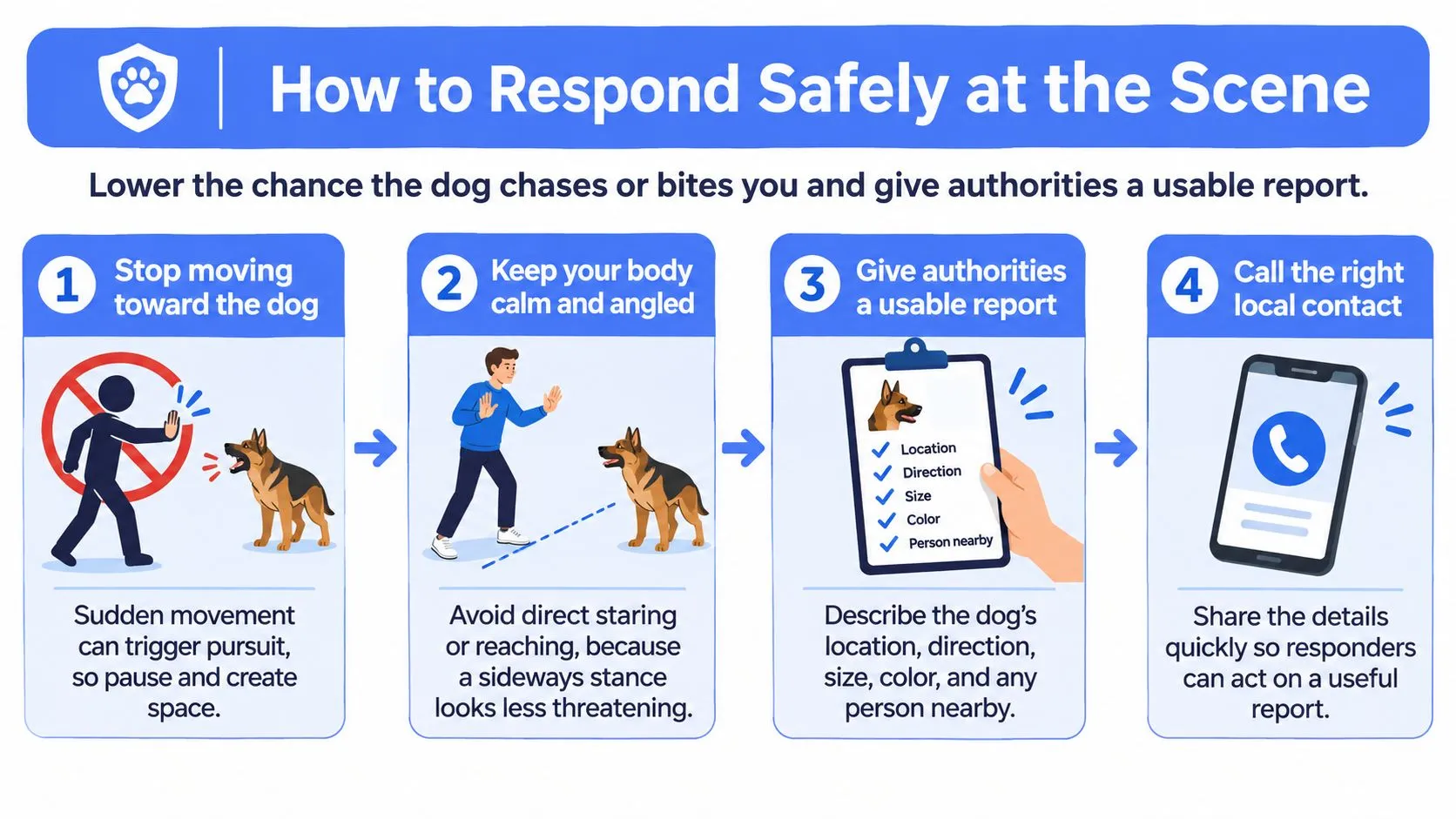
- Stop moving toward the dog. Pause and keep a clear route behind you. Walking straight at an unfamiliar dog or making sudden movements may increase tension.
- Turn sideways and stay calm. Avoid direct eye contact and stand with your side facing the dog. This posture is less confrontational than squaring up and staring.
- Use a firm, low voice if needed. Give a short command without shouting, then slowly back away. Running or screaming can prompt pursuit.
- Do not chase, corner, grab, or carry the dog. A frightened dog may react unpredictably, even if it seemed friendly at first. Leave capture to trained responders.
- Move children and pets out of the dog’s path. Keep them behind you and away from the animal. Do not let children reach toward it.
- Note four details before the dog leaves. Record the time, direction of travel, color and markings, and whether you saw a collar or tag. A clear location and these details can help responders identify where to look.
- Report a bite or concerning behavior promptly. If the dog has bitten someone, appears injured, or is acting unusually, contact animal control or police. Do not approach it to investigate.
Why Stillness Beats Running
The CDC’s guidance on preventing dog bites recommends staying still and calm, avoiding direct eye contact, standing with your side facing the dog, using a firm low voice, and slowly backing away. Running or screaming can prompt a chase.
Practical rule: If you would need to reach for the collar to read a tag, stay back. Read only what you can see from a safe distance.
A safe outcome means you are away from the dog, children and pets are clear, and responders have a useful location to work from. If you are also concerned about personal safety while walking, these precautions for walking alone at night also emphasize awareness, distance, and a way to reach help.
Who to Call Based on What the Dog Is Doing
The right contact depends on what the dog is doing, not only where it is. A calm dog sniffing mailboxes needs a different call from a dog lunging at people in a crosswalk. Bites and possible rabies signs change the route because public-health staff may need to assess exposure, arrange observation, and decide what happens next.
Start by naming the situation in plain words. Is the dog friendly or threatening, identified or unknown, injured, contained, or still moving? Has it touched a person or another animal? That quick classification tells dispatch whether you need routine pickup, urgent field response, medical help, or a public-health referral.
Who to Contact by Dog Situation
| Situation | Who to Contact | Timing |
|---|---|---|
| Friendly dog with a visible tag or microchip | Owner listed on the tag, then animal control if no answer | Same day |
| Friendly dog with no ID | Local animal control non-emergency line or shelter | Same day |
| Injured dog, not threatening | Animal control or a veterinarian | Promptly |
| Dog threatening people or traffic | 911 if people or drivers face immediate danger, or animal control’s emergency line | Immediately |
| Dog has bitten someone | Animal control or police, plus medical care for the person | Immediately |
| Dog showing neurological signs | Animal control and public-health authority | Immediately |
| Dog that cannot be observed for quarantine after a bite | Animal control and public-health authority | Immediately |
A visible tag is the one case where calling the owner first can be the fastest safe option, but only if you can read it without approaching or grabbing the dog. If the number doesn’t answer, don’t hold the dog in your garage for days. Call animal control or the shelter so the dog enters the system owners usually check first, and ask whether a veterinarian or shelter can scan for a microchip.
Use 911 when a dog is actively threatening people, running through traffic in a way that could cause a crash, or a bite needs urgent medical care. Use the non-emergency animal-control number for a stray that’s calm and not creating an immediate hazard. If you’re checking whether an incident is already drawing an emergency response nearby, a tool for reviewing active 911 calls can help you understand call activity, but it doesn’t replace making your own report for a dog you’ve seen.
Save two numbers in your phone today, your animal-control daytime line and its after-hours route. Many areas route nights and weekends through police non-emergency dispatch. Knowing that path before you need it prevents the common delay of searching online while the dog disappears.
What to Record for a Useful Report
A good report is a time-stamped record, not just an address. Dispatchers, shelter staff, and owners match reports by small details, and those details fade fast. Write them in your phone while you’re still in a safe place.
- Exact location: Add a cross street, landmark, trail marker, or business name, because crews need a point they can find quickly.
- First seen and last seen times: Timing shows whether the dog is likely still nearby or has had time to leave the area.
- Direction of travel: State the street and direction, such as north on Elm toward the school, because it guides the search.
- Appearance and identification: Record color, size, markings, breed type if obvious, and any collar or tag, because owners and shelters match lost-pet reports with those facts.
- Injuries: Note limping, bleeding, or trouble breathing, because an injured dog needs a faster, more careful response.
- Behavior: Say whether the dog seemed friendly, frightened, aggressive, disoriented, or unusually wobbly, because behavior sets the triage level.
- Contact and containment: State whether it touched a person or animal and whether it’s now contained, because contact drives bite reporting and containment changes the response.
Take photos only from a distance and only when it’s safe. Don’t crouch in front of the dog, use flash near its face, or follow it for a better angle. One clear side photo and one wider photo showing a landmark are more useful than ten blurry close-ups.
The scale helps explain why coordination matters. Washoe County’s published 2025 animal services statistics record 9,111 reports of pets running loose in 2025, alongside 2,584 stray dogs reunited with their families, and show 42% of all stray dogs and cats were reunited. Your record supports that reunification process and, after a bite or collision, gives investigators a reliable timeline. The same habit of preserving times, photos, and witness details matters after a car accident on Airport Road or any other road incident, because agencies reconstruct events from contemporaneous notes.
Finish with a simple log. Save the report reference number, your photos, messages with the owner or shelter, and the names and contact details of witnesses. Don’t edit the timeline later to make it neater. If you remember a new fact, add it with the time you remembered it.
What to Do After a Bite
Put actions in this order. Call animal control or police so the bite is on record, get medical care for the person, and write down the time, place, and dog description while details are fresh. If bleeding or injury needs urgent care, call 911 first and make the animal report as soon as you can.
Ask the responding authority two direct questions. What’s the local bite-reporting deadline, and who will observe the dog for quarantine? Animal control may be able to locate and observe the dog, or the public-health authority may order the observation and tell you what exposure assessment requires. Don’t assume a deadline from another city applies where you live.
Exchange names and phone numbers with the owner if the owner is present, and record tag information and rabies vaccination details if they’re available. Keep the exchange factual. Don’t debate fault at the scene, apologize for things you didn’t do, or accuse the other person of breaking a specific law. Short statements made under stress can shape later claims, and neither side has the full record yet.
Keep every receipt and image. Photograph injuries, torn clothing, damaged property, and the place where the bite happened, then save medical bills, veterinary invoices, and repair estimates. Under broad bite-liability rules, those records may support claims for medical costs, property damage, and veterinary costs.
A calm, documented exchange serves everyone who has to act next. Animal control gets a traceable dog, public-health staff get exposure facts, and any insurer or decision-maker gets records created close to the event.
Owner Responsibilities and Liability Exposure
Your core duty as an owner is simple to state and sometimes hard to maintain. Keep your dog contained on your property and under control in public. That’s the first thing most ordinances test after an escape, and it’s the cheapest point at which to prevent a citation, injury, or claim.
Practical Duties That Prevent Most Cases
- Secure fences and gates: Repair gaps, weak latches, loose boards, and digging spots before your dog finds them again.
- Use a leash and able handler in public: A leash in the hand of someone who can’t hold the dog isn’t real control.
- License and register where required: Keep contact information current so a finder or shelter can reach you fast.
- Maintain rabies vaccination: Keep records accessible, not buried in an old email or a previous veterinarian’s portal.
- Use visible ID and a microchip: A tag helps a neighbor call you, and a chip helps when a collar slips off.
- Report escapes promptly: Call animal control and nearby shelters with a description, last location, and your phone number.
Liability can reach beyond a leash ticket. Under North Carolina’s newer approach, owner liability may arise when a dog injures a person, domestic animal, livestock, or poultry. Florida’s broad bite liability shows another model, and owners may also face claims for property damage, medical bills, and veterinary costs after an incident. The exact damages and defenses come from the law where the event happened, so don’t rely on what happened to a friend in another state.
The “my dog never bites” defense also has limits. In a regime that imposes liability regardless of prior knowledge of viciousness, a clean history may not protect you from responsibility for a first bite. Prior behavior can still matter for dangerous-dog proceedings, penalties, or insurance, but it isn’t a universal shield.
Vaccination connects your household duty to public health. The World Health Organization’s rabies fact sheet identifies mass canine vaccination as the most cost-effective way to prevent human rabies and sets an operational benchmark of at least 70% vaccination coverage in each at-risk dog population, generally achieved within a month of a campaign. Free-roaming, unidentified dogs make that coverage harder to verify, while identifying, containing, and registering loose dogs helps officials locate unvaccinated animals and target follow-up vaccination.
After an escape, retrieve your dog safely, document exactly how it got out, notify the authority if your code or the incident requires it, and fix the containment gap before the dog goes back into that space. A photo of the failed latch or dug-out corner helps you repair the right problem instead of guessing.
Prevention Steps and Sample Municipal Language
Most escapes happen during ordinary disruption, not dramatic events. Moving day leaves doors propped open, holidays bring visitors who don’t know your dog darts, deliveries require repeated gate openings, and fence repairs create temporary gaps. Build one habit for each moment, and you’ll remove the opportunities your dog relies on.
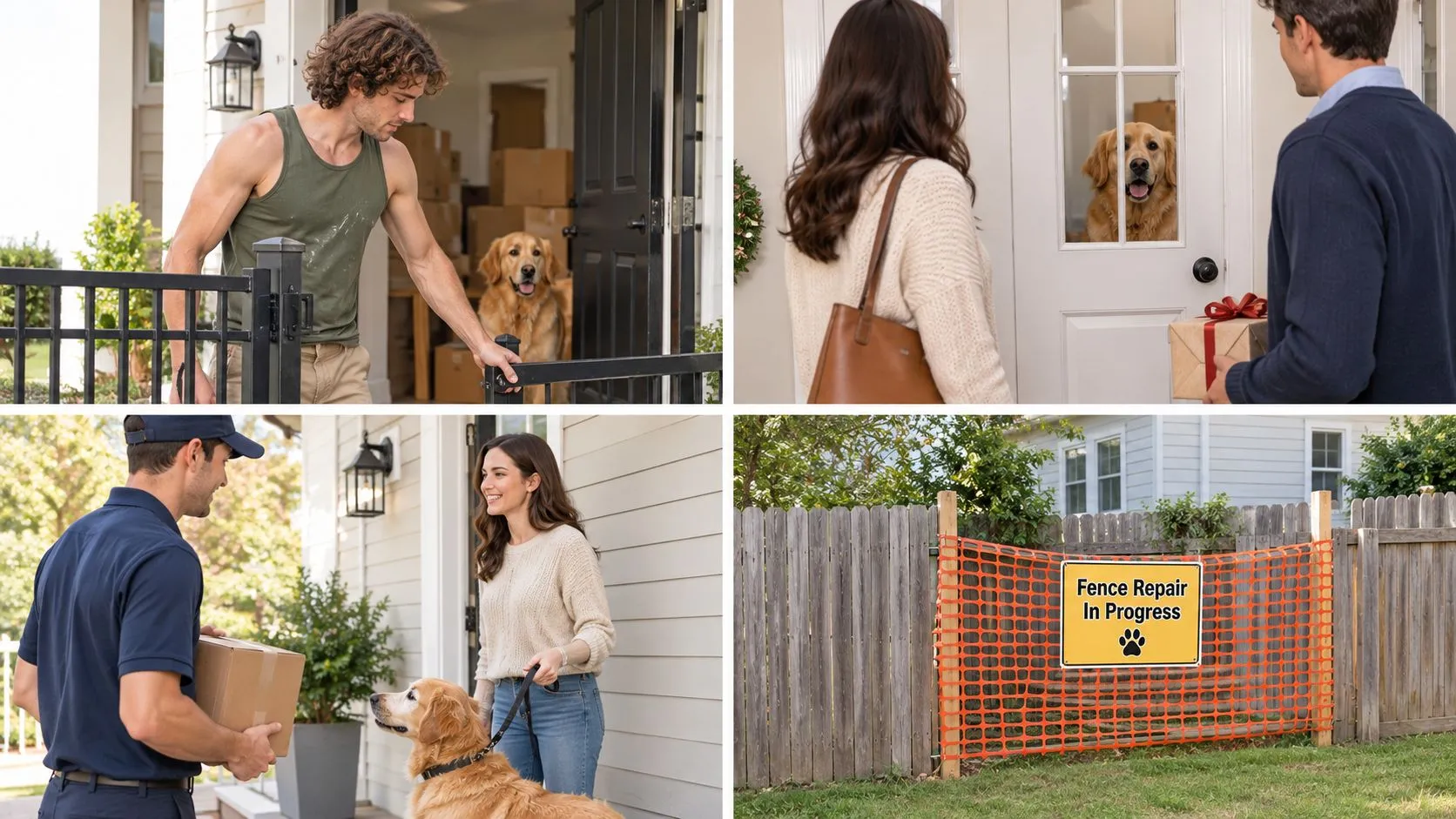
- Moving day: Put the dog in a closed room or crate with a sign on the door before movers arrive.
- Visitors and holidays: Keep a leash by the entry and tell guests not to open the gate or front door for the dog.
- Deliveries: Use a secure indoor holding spot before opening the door, rather than blocking the dog with your foot.
- Fence repairs: Walk the full line after work, test every latch, and check for soft soil where digging starts.
If digging is your repeat problem, review anti-dig details for chain link fencing from FenceScape as you plan the repair, since the right bottom edge, buried barrier, and tension details matter more than making the fence taller. A gate-latch check takes seconds. Do it every time you come through, and teach everyone in the household to pull the gate until it clicks.
Sample Language for Comparing a Local Code
Definition. “Dog at large” means a dog not on the owner’s property and not under the physical control of a competent person by leash or other restraint.
Owner duty. An owner must prevent the owner’s dog from running at large and must maintain fences, gates, and other enclosures used to confine the dog in good repair.
Reporting. Any person who observes a dog at large may report it to animal control. A person with knowledge of a dog bite must report the bite to [animal control or designated authority] within [number] hours. A violation may be subject to a fine of [amount] dollars as provided in [penalty section].
The definition tells readers what conduct the rule covers, so check whether your code includes escapes and off-leash dogs or only dogs off the owner’s premises. The owner-duty clause turns containment into an ongoing maintenance obligation, not just a duty to apologize after an escape. The reporting clause gives bystanders a clear path and sets a bite deadline, which is why the bracketed [number] hours and [amount] dollars must come from a real adopted code, not a template.
Treat the sample as illustrative language for comparison or discussion, not as law you can enforce. Before relying on it or proposing it, check the ordinance and state law in force where you live, and have municipal counsel review definitions, notice, penalties, quarantine authority, and appeal rights. Clear language helps, but only adopted local law decides what you and your dog face.
When a loose dog turns a routine walk into an urgent situation, 3rd-i lets you stream live video, audio, and location to selected contacts and trained Safety Agents who can help coordinate help, and our SOS feature alerts trained dispatchers with a live stream and real-time location. Keep your local animal-control number saved, prepare the report details you would need, and visit 3rd-i to set up a faster way to reach people who can see what is happening and act.