
Car Accident on Airport Road: What to Do Right Now
The horn is still going. Your shoulder hurts, your hands are shaking, and you’re trying to figure out whether this is just a bent bumper or a real emergency. If you’re on an airport road, treat it like a serious access incident, not a routine fender-bender. Your first job is to keep people alive and keep the scene from turning into a second crash.
Table of Contents
- The First Sixty Seconds After Impact
- Why Airport Roads Are a Different Kind of Crash Scene
- Who to Call and In What Order
- Using a Live Safety App Without Replacing 911
- Documenting the Scene Before Anyone Moves
- Filing the Right Reports and Working Your Insurance Claim
- A Printable Next-Time Checklist
The First Sixty Seconds After Impact
The airbags have gone off, or maybe they haven’t. Either way, don’t start by reaching for your insurance card. Start by checking yourself, then every passenger, then anyone outside the car who may have been hit or stepped into traffic.
If you can speak, move your fingers and toes. If someone is bleeding heavily, apply firm pressure with whatever clean cloth you have. If a door opens into an active lane or another car is bearing down, move only as far as needed to get out of immediate danger.
Turn on your hazards right away. If you carry reflective triangles or flares, use them only if you can do it without walking into traffic, because airport approaches can be fast, narrow, and full of distracted drivers looking for terminals instead of brake lights.
Practical rule: If the car is blocking an active lane, or if another impact is likely, get it out of the way. If it isn’t, leave it where it is until help arrives.
At this point, don’t debate fault with the other driver. Don’t chase witnesses. Don’t start swapping long explanations. A calm, short call to 911 beats a messy conversation every time, and Bell Law’s guide on what to do after a car accident is a useful reminder that the early minutes are about safety first, paperwork second.
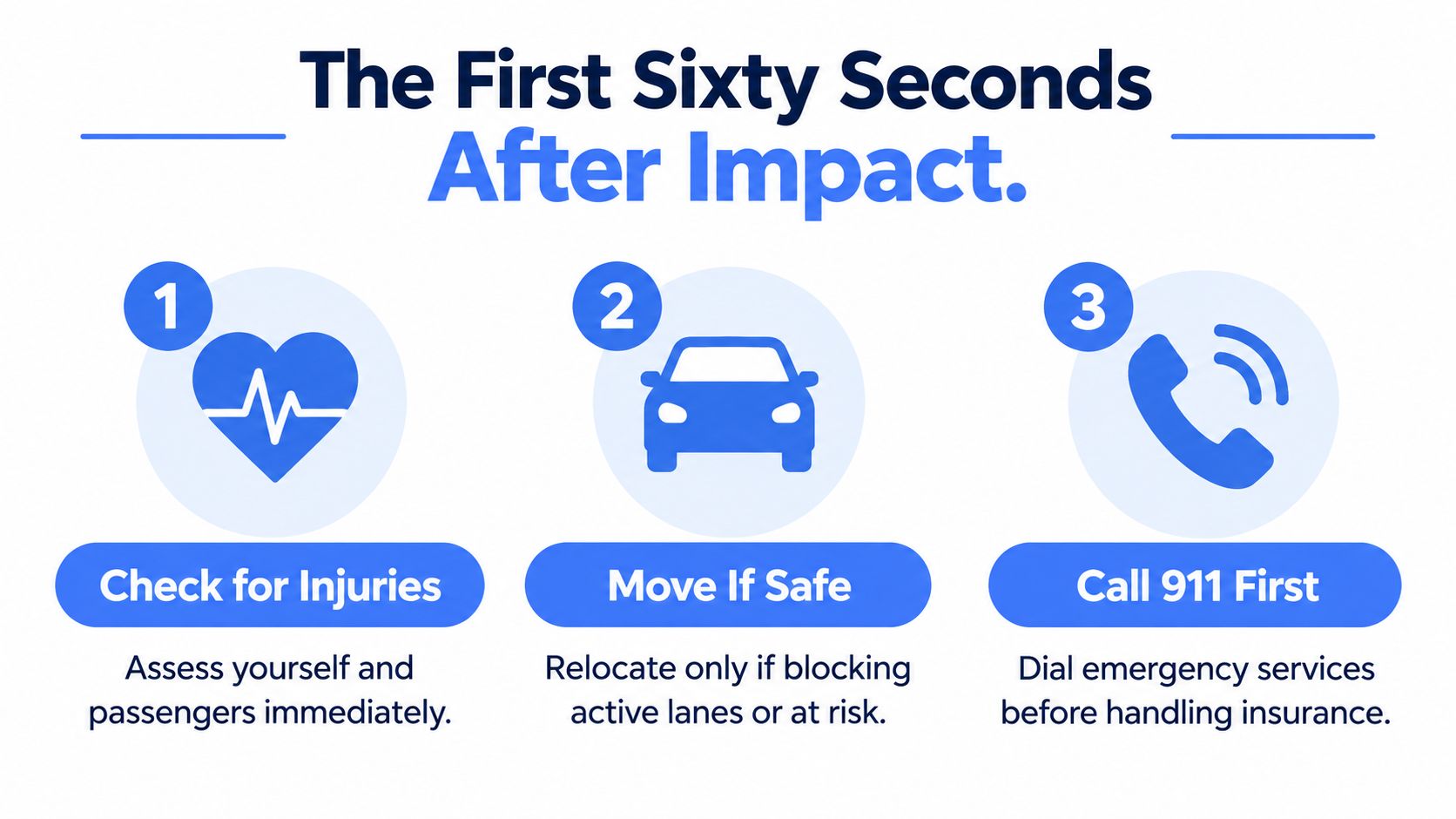
A car accident on airport road can feel minor from the driver’s seat and dangerous from the curb. Treat it like a scene with secondary-crash risk until you know otherwise.
Why Airport Roads Are a Different Kind of Crash Scene
Airport roads look ordinary until they don’t. Drivers are merging toward terminals, cutting across lanes for the right entrance, and reacting to signs, barriers, taxis, rideshares, buses, luggage carts, and pedestrians all at once. That mix creates a crash scene with more confusion than a normal street, which is exactly why airport roads need their own response playbook.
Local corridor assessments have shown that airport access routes can produce repeated crash clusters where turning, merging, and curbside access collide. In Spokane, the Airport Drive corridor was assessed for crash patterns over multiple years, and the result was a clear warning about injury risk and heavy traffic pressure on the same roadway. The point is not just volume. It is the way airport traffic mixes fast-moving through drivers with people trying to reach a terminal, a curb, or a parking entrance.
A similar pattern appears near Syracuse Hancock, where reported crashes along the access network included rear-end collisions and roadside-object or animal impacts. That matters because airport roads often fail in the same predictable places, at entrances, near lane shifts, and where drivers hesitate to choose the correct curb or exit. Even when a crash seems minor, the scene can clog quickly and create a second hazard for anyone who steps out without understanding the layout.
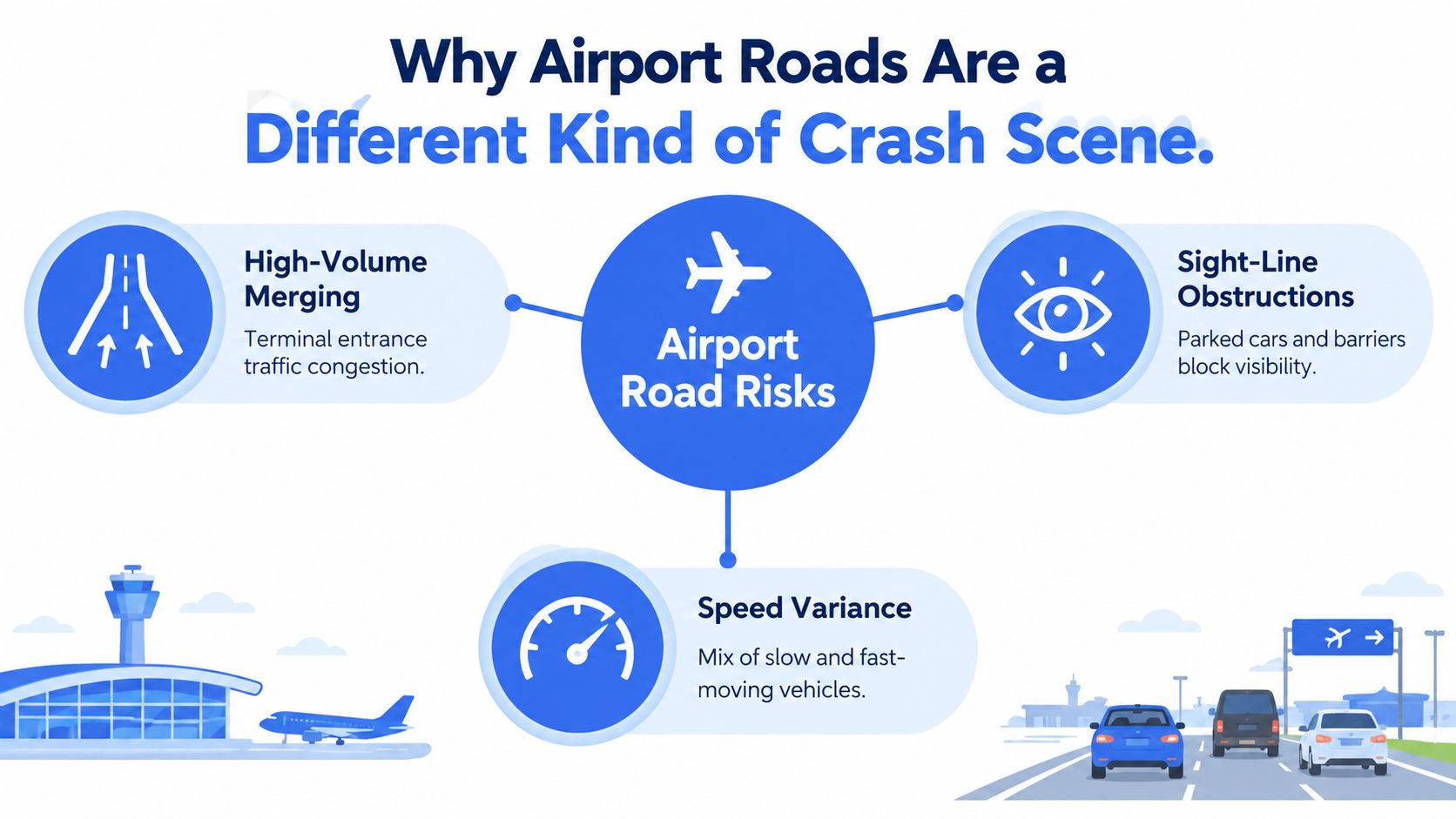
Airport roads behave like dense urban arterials, not low-stress pickup lanes. If you respond like you’re on a quiet frontage road, you’ll miss the risks that matter.
That is why you should judge the scene by access control, congestion, and visibility. On airport property, the question is not only who hit whom. It is who can reach the crash, who can leave safely, and who might get struck next.
Who to Call and In What Order
Start with 911 if anyone might be hurt, if traffic is blocked, or if you can’t tell whether the crash is on public roadway or airport-controlled property. Give the dispatcher the shortest accurate version possible. Say the airport name, the terminal or entrance if you know it, the lane or direction of travel, and whether vehicles are blocking an exit or curb lane.
If the crash is on airport property, airport operations needs to know too. On a terminal curb, service road, garage exit, or other airport-controlled area, the airport may have its own response channel in addition to police and fire/EMS. If you can see airport signage, lane markings, or controlled curbside rules, that’s your clue that operations should be looped in quickly.
If you’re on a public access road outside the controlled zone, keep the call focused on emergency response and law enforcement. Don’t waste time trying to solve jurisdiction from the shoulder. Dispatch can route the right agencies if you give a clear location, and a specific entrance beats a vague “near the airport” every time.
Useful rule: report the crash once, clearly, and in the order that protects people, not paperwork.
When the scene is stable, notify your insurer. If a rideshare app or rental-car contract applies, report through that channel too, because those systems often require separate notice. For help with the reporting workflow, the internal resource at 3rd-i’s emergency dispatch app is relevant because it shows how location and incident details can be carried into an emergency call without losing the human context.
The point is not to call everyone at once. The point is to make sure the right people hear the right location details while the scene is still readable.
Using a Live Safety App Without Replacing 911
A live safety app helps most when you’re rattled, alone, or trying to describe a confusing curbside crash while traffic keeps moving around you. In that moment, the app should do one job, get a real human on the line, keep the stream open, and preserve what’s happening until responders have the picture. It does not replace 911 when someone may be injured.
Here’s the right use case. You’re in a terminal pickup lane, your head is spinning, and you can’t tell whether you’re at the main entrance or the garage exit. A trained Safety Agent can look at the live video, hear what’s happening, confirm the entrance, and relay that context to dispatch through escalation systems such as RapidSOS. That matters because airport roads punish vague location descriptions.
The same workflow can help with evidence after the fact. Continuous video, audio, route data, and transcription create a record of what happened before and after impact, which is more useful than a single photo of a damaged bumper. One practical option in this category is 3rd-i’s 24-hour live monitoring app, which is built to stream live video, audio, and location to selected contacts and trained Safety Agents with emergency escalation when needed.
If you’re using any live-streaming app, use it as a support tool, not a shield. Call 911 first for injuries, blocked lanes, or signs of danger. Then let the app help you stay oriented, preserve the scene, and keep witnesses, contacts, and dispatch synchronized.
Documenting the Scene Before Anyone Moves
The moment the scene is safe enough to work, start recording what can disappear in minutes. Take one wide shot that shows the terminal entrance, curb zone, or intersection. Then step in and capture damage, debris, lane markings, and anything that blocked sight lines, like parked cars, signs, barriers, or landscaping.
If you have dashcam footage, save it before it loops. If another vehicle has visible camera gear, ask the driver to preserve the clip now, not later. A dash cam such as the Rexingusa M2 Max mirror dash cam can be useful here because continuous recording is often the only clean record of lane position, signal phase, and sudden braking.
Write down the facts while they’re fresh. Keep it plain and ugly, not polished.
- Direction of travel: Note which way each vehicle was moving.
- Road position: Record the lane, curb zone, ramp, garage exit, or terminal entrance.
- Signal or queue status: Write whether traffic was stopped, turning, or creeping.
- Witness details: Get names and phone numbers before they leave.
- Exact statements: Jot down the other driver’s words, without arguing about fault.
Preserve any live video, transcription, or AI summary the same day. If you used an app with route streaming, save that too, because a static photo never shows the full sequence of movement that led to impact.
Don’t let witness contact turn into a roadside trial. Get the number, thank them, and move on.
For live-capture workflows, the internal reference at 3rd-i’s live video streaming app fits this step because the value is in keeping the timeline intact while the scene is still evolving.
Filing the Right Reports and Working Your Insurance Claim
Once the vehicles are moved and the scene is clear, paperwork starts. Ask for the police report or airport operations report number before you leave, then request a copy as soon as it’s available. If the crash happened on airport-controlled property, that report matters because it helps identify where the event occurred and which authority responded.
Handle insurance in two tracks. First, file the liability claim tied to the crash itself. Second, check whether you have medical payments or uninsured-motorist coverage that applies if pain or injury shows up after the adrenaline fades. Don’t guess on coverage, read the policy or have the insurer spell it out.
If a rental car or rideshare is involved, report through that system too. Those contracts and platforms often have separate notice rules, and missing them creates unnecessary friction later. Keep the photos, video, witness notes, and any live-app transcript together so you can support the claim without overstating what the evidence proves.
Airport-road crashes become legal problems faster than ordinary parking-lot bumps when multiple vehicles, injuries, or unclear control of the roadway are involved. That’s also when a lawyer becomes worth the call, especially if the crash involved suspected impairment, delayed symptoms, or a pileup with several agencies and multiple reports.
The goal is not to build a dramatic file. The goal is to create a clean record that shows where the crash happened, who responded, and what the scene looked like before it changed.
A Printable Next-Time Checklist
Keep this on your phone and use it under pressure.
- Stay safe first. Check for injuries, hazards, and secondary crash risk.
- Call 911. Say the airport name, terminal or entrance, lane, and whether anyone is hurt.
- Report to airport operations if you’re on airport property. Give the exact curb, door, or road access point.
- Photograph and save evidence. Wide shots, close-ups, dashcam, witnesses, and timestamps.
- Notify your insurer. Open the liability claim and ask about medical coverage if symptoms develop.
- Report to rideshare or rental-car support if needed. Don’t rely on one report to cover everything.
- Save every recording. Keep video, audio, and transcripts before they overwrite.
- Use a live safety app if you’re alone or shaken. It can help relay location and context, but it never replaces 911.
If you’re injured, disoriented, or trying to manage this alone, use a tool that puts a trained human on the line fast and keeps your location moving toward the right responder. That’s where app-based escalation helps, because airport roads punish vague location reports and delayed calls.
3rd-i gives you live video, audio, route sharing, and Safety Agent support with 911 escalation through RapidSOS, which fits this exact kind of airport-road incident. If you want a faster way to get precise location context, preserve evidence, and keep someone with you while you’re shaken, visit 3rd-i.