
Can't Find My Keys: A Practical Search Plan
You’re standing by the door with one shoe on, your hand hovering over the empty hook. The pockets you’ve already checked feel personally insulting. You’re late, your plans are starting to wobble, and the keys are probably somewhere nearby, hiding in the exact place you’ve looked at twice.
The usual response is to search faster. That rarely helps. Panic narrows attention, sends you back to the same obvious surfaces, and makes cluttered or transitional spots almost invisible. A better search treats the problem as a small investigation: identify the context, reconstruct the keys’ path, then sweep the area systematically.
Table of Contents
- That Sinking Feeling When You Can’t Find My Keys
- The Most Common Places Keys End Up
- A Smarter Way to Search Room by Room
- The Five-Minute Home Sweep Checklist
- Smart Trackers and How to Set Them Up
- Daily Habits That Stop the Cycle
- When Key Loss Tends to Spike
That Sinking Feeling When You Can’t Find My Keys
The frustration is understandable. A lost key ring can turn a normal exit into a frantic tour of the house, complete with sofa cushions lifted, bags emptied, and the same kitchen counter inspected again because it somehow looks different the third time.
The disruption adds up. A 2017 consumer survey reported that the average American spends 2.5 days per year looking for lost items, while 28% said they misplace car and house keys at least weekly. More than half also said misplaced items regularly make them late for work or school, according to the consumer survey report on lost belongings.
Why random searching fails
Nearly everyone begins with the hook, the counter, and the last pair of trousers they remember wearing. Then the search becomes circular. You walk through the same rooms, open the same drawer, and mentally mark places as checked without remembering exactly what you inspected.
Practical rule: Slow down before you speed up. A methodical search covers more ground than a panicked one.
The reliable approach has three parts:
- Start with context: Check transitional locations first, including the entryway, bags, pockets, car, and surfaces touched during your last movement.
- Use a grid: Divide each room into sections and inspect each section completely, rather than scanning the whole room vaguely.
- Save oddities for last: Search refrigerators, shoes, laundry, and unusually high or low spots only after the likely route is clear.
A useful prevention overview, including ways to reduce everyday loss, is InchBug’s loss prevention guide. For the immediate search, begin where your routine changed, then move backward through the last place you used the keys.
The Most Common Places Keys End Up
Keys usually disappear during a transition, not during a deliberate decision to put them somewhere strange. You open the door while carrying groceries, answer a call while taking off a coat, or drop your bag before the key ring reaches its normal home.
Start with these zones, in roughly this order:
- Entryway surfaces: Check the console, shoe rack, mail pile, door ledge, and the floor beside the hook. The entryway is a natural drop zone, but visual clutter makes a small key ring blend in.
- Jacket and coat pockets: Check every pocket in the garment you wore, then yesterday’s coat. Don’t rely on memory. Turn each pocket inside out.
- Bag interiors: Empty the main compartment, zipped sections, laptop sleeve, and side pockets. A key ring can slide beneath a notebook or catch behind a laptop-bag flap. If your everyday tote has multiple compartments, a guide to organizing tote compartments can help you assign one permanent pocket.
- Sofa and chairs: Run your hand along cushion seams, under throws, behind the back cushion, and beneath the furniture. Keys often fall when you sit down and empty your pockets.
- Kitchen surfaces: Inspect the counter, fruit bowl, appliance tops, and the area beside the fridge. A person carrying food or sorting mail may park keys there without noticing.
- The refrigerator: Check the top, door shelf, and nearby magnets. It sounds absurd until a key ring is placed down while someone reaches for a drink.
- Bedroom and bathroom: Look at the bedside table, dresser top, laundry basket, sink shelf, and toilet tank area. These are common places to pause while changing clothes or washing up.
- Shoes and low clutter: Check inside yesterday’s shoes, beneath newspapers, under furniture, and beside the laundry hamper.
- Car and outdoor transition points: Inspect the cupholder, center console, door pocket, driveway, and the lock itself. Yesterday’s drive may be more relevant than today’s memory.
The reason for ranking matters. You’re not trying to guess the single magical hiding place. You’re checking locations that match the last movement sequence, then widening the search only when that sequence is exhausted.
A Smarter Way to Search Room by Room
A room-by-room sweep works because it gives your attention a boundary. Instead of asking, “Where are my keys?” you ask, “Have I fully cleared this quarter of the living room?”
Build the grid
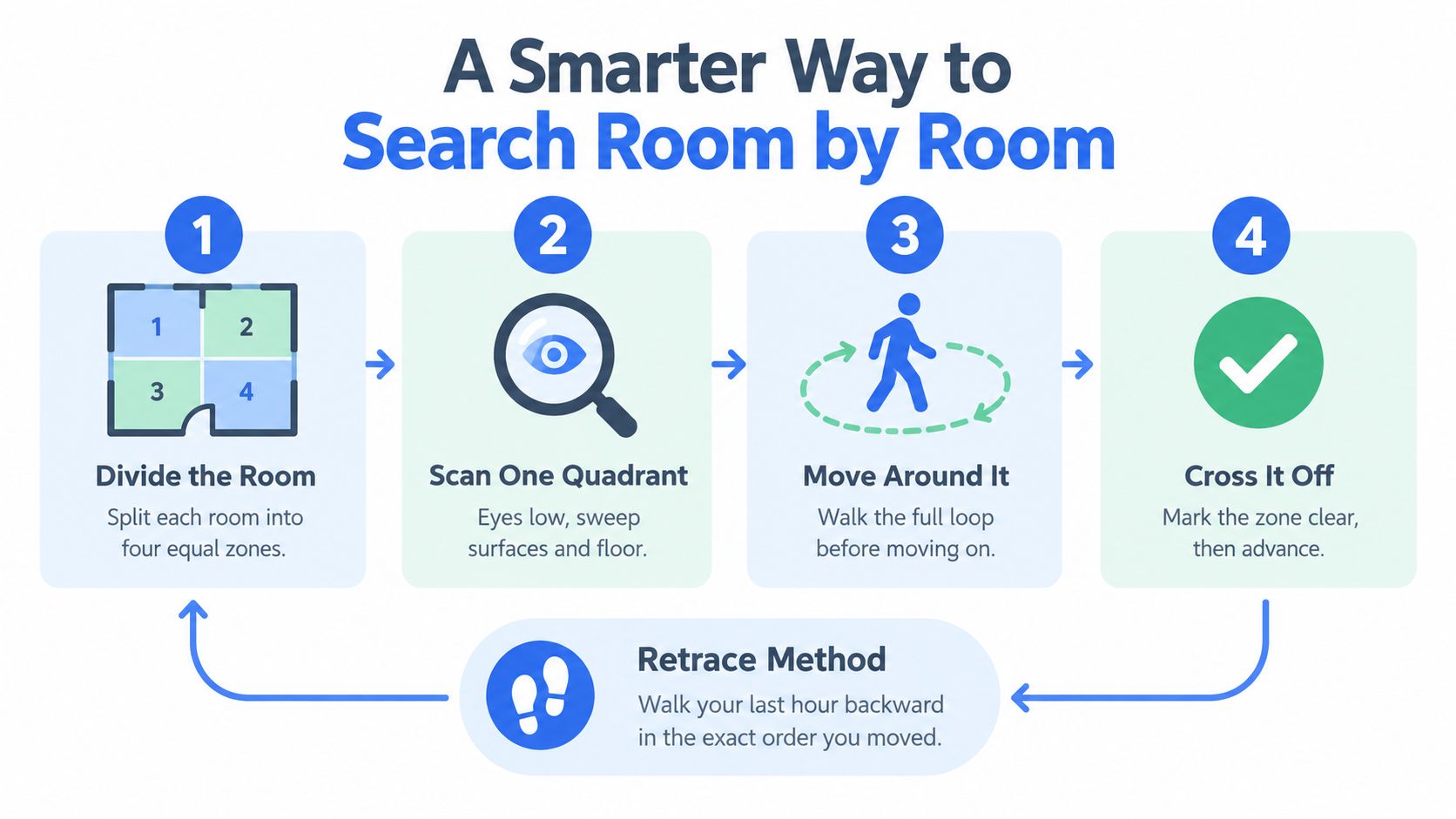
Choose one room and divide it into four zones. The divisions can be imaginary, using furniture, walls, or floor tiles as landmarks.
- Choose a starting corner: Begin at the doorway and move clockwise, or start at the area closest to the last known location.
- Scan one quadrant: Look at surfaces first, then furniture gaps, then the floor. Move from left to right and top to bottom.
- Change your position: Walk around the quadrant so you see it from different angles. Check behind objects, not just the open space around them.
- Mark it clear: Put a note on your phone or make a physical mark on paper. Don’t trust your memory to remember which section you searched.
The last step prevents the most irritating failure, returning to the same clear area while an unchecked zone waits nearby.
Reconstruct the route
Now replay the last ten minutes before you noticed the keys were missing. Start with the last confirmed use, then move backward. Think about your hands, not just your locations.
Did you set something down to answer a call? Empty a pocket before changing clothes? Swap a work bag for a tote? Carry groceries from the car? Those actions point to likely drop zones. Check the laptop bag flap, the seam between couch cushions, the top of wall hangings, the area beneath the toilet tank lid, and any freezer drawer or shelf used as a temporary catchall.
Search the path your hands took, not just the rooms your feet entered.
Transitional places deserve special attention because routines pause there. Inspect the entryway table, kitchen fridge, bathroom sink shelf, and bedroom dresser top before investigating truly unusual locations.
If you still can’t find my keys after one complete sweep, stop and reset. Pick a new start point, use the grid, and cross off each section. Circling the house feels active, but it doesn’t improve coverage.
The Five-Minute Home Sweep Checklist
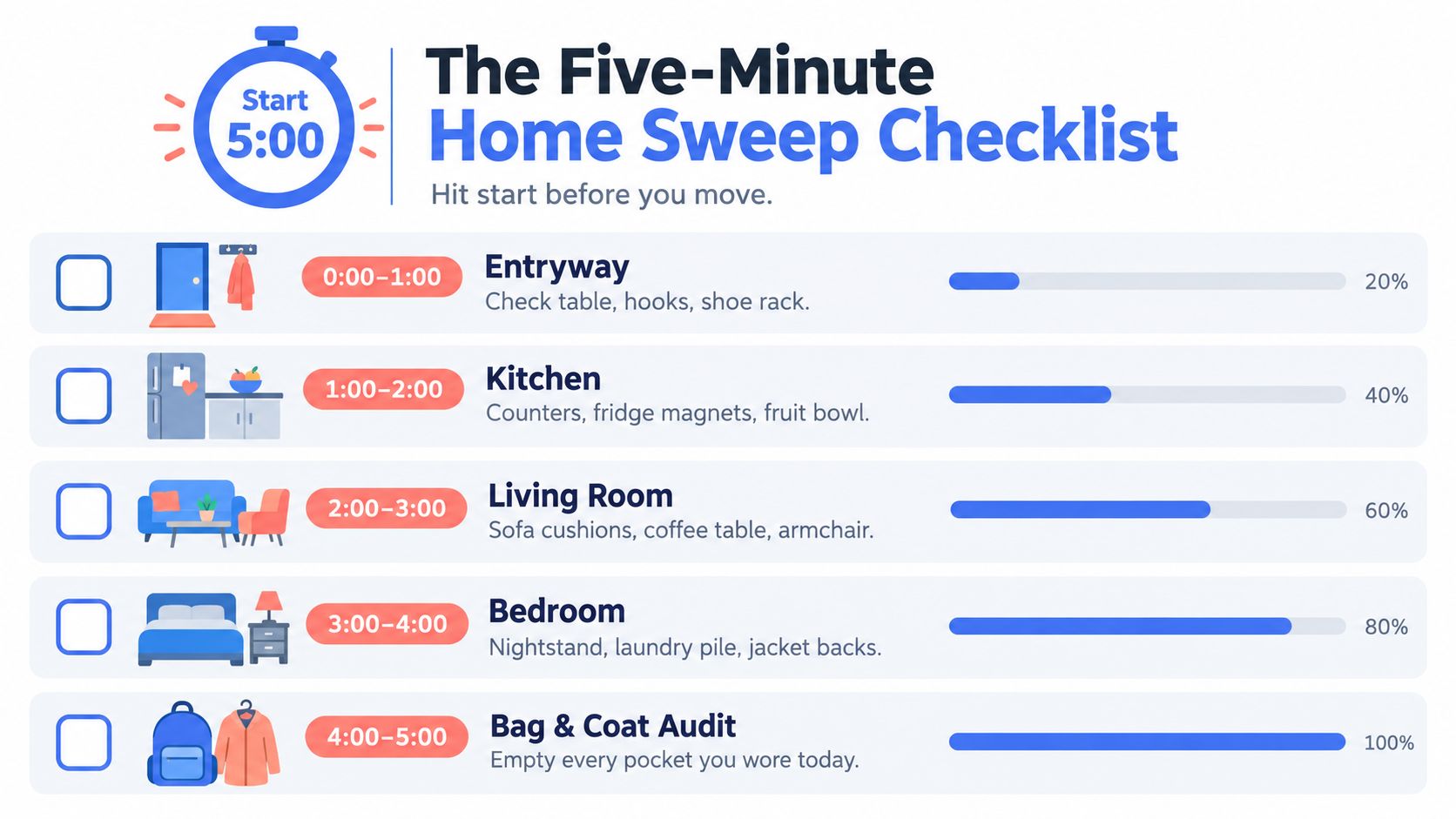
Set a timer for five minutes before you begin. The timer isn’t a claim that every search will finish within that period. It creates a boundary that keeps you moving instead of letting frustration take over.
- Entryway: Check the table, hooks, shoe rack, doorknobs, mail, and the floor beneath the usual drop zone.
- Kitchen: Search counters, the fruit bowl, fridge door and top, appliance surfaces, and the space beside the bin.
- Living room: Lift sofa cushions, inspect seams, check the coffee table and armchair, and look under throws.
- Bedroom: Check the nightstand, dresser, laundry pile, jacket backs, and the floor beside the bed.
- Bathroom: Inspect the sink shelf, toiletry basket, laundry hamper, and toilet tank area.
- Bag and coat audit: Empty every pocket and compartment from everything you wore or carried today.
- Low-level sweep: Look beneath furniture, inside yesterday’s shoes, behind baskets, and along baseboards.
- Exit-path check: Stand at the front door and trace every route you took after arriving home.
The last step is the pin-drop rule. From the doorway, mentally place yourself at each stop, including where you put down groceries, answered a message, removed wet clothing, or switched bags.
Once you find them, don’t just celebrate and move on. Notice the trigger. That observation tells you which prevention habit to build tonight. A designated bowl won’t help if you leave it behind the mail pile, so make the drop zone visible, reachable, and hard to bypass.
For a physical tracker setup that can help locate a tagged key ring, see this Bluetooth key tracker option.
Smart Trackers and How to Set Them Up
A tracker is useful when the keys have a compatible tag attached. It won’t locate an untagged key ring, and it won’t replace a reliable drop zone. Choose based on the phone ecosystem you already use, how you feel about replaceable batteries, and whether you want a broader finding network.
| Feature | Tile | AirTag-style | Chipolo |
|---|---|---|---|
| Phone ecosystem | Works across common phone platforms through the Tile app | Closely integrated with Apple devices | Offers models designed for different phone ecosystems |
| Finding method | Nearby Bluetooth finding and Tile’s community network | Nearby Bluetooth finding and Apple’s Find My network | Nearby Bluetooth finding and Chipolo’s compatible network |
| Battery approach | Depends on the model, with replaceable and sealed options | Model-dependent, commonly designed around a replaceable coin battery | Varies by model, including replaceable and sealed designs |
| Best fit | Mixed-device households or users who want a standalone app | People already using Apple devices and Find My | Users who prefer Chipolo’s app or ecosystem options |
| Main trade-off | Feature experience depends on the Tile app and network participation | Strong ecosystem integration can mean more platform dependence | Model choice matters because features differ across products |
Attach the tag to the most-used key ring, not the spare. Name it “House Keys” or “Car Keys,” so an alert identifies the object instead of displaying an unhelpful device label. Then test the sound and location process before you need it.
For a more structured phone reminder system, an iPhone to-do list that works can support the habit around the tracker rather than leaving the technology to carry the whole burden. Set separation alerts where available, review sharing settings, and understand privacy zones before relying on notifications.
A tracker attached to the key ring can make the search faster when the tag has battery and range. For another key-focused hardware approach, compare a key fob tracker, then decide whether its form factor suits the ring you normally carry.
Daily Habits That Stop the Cycle
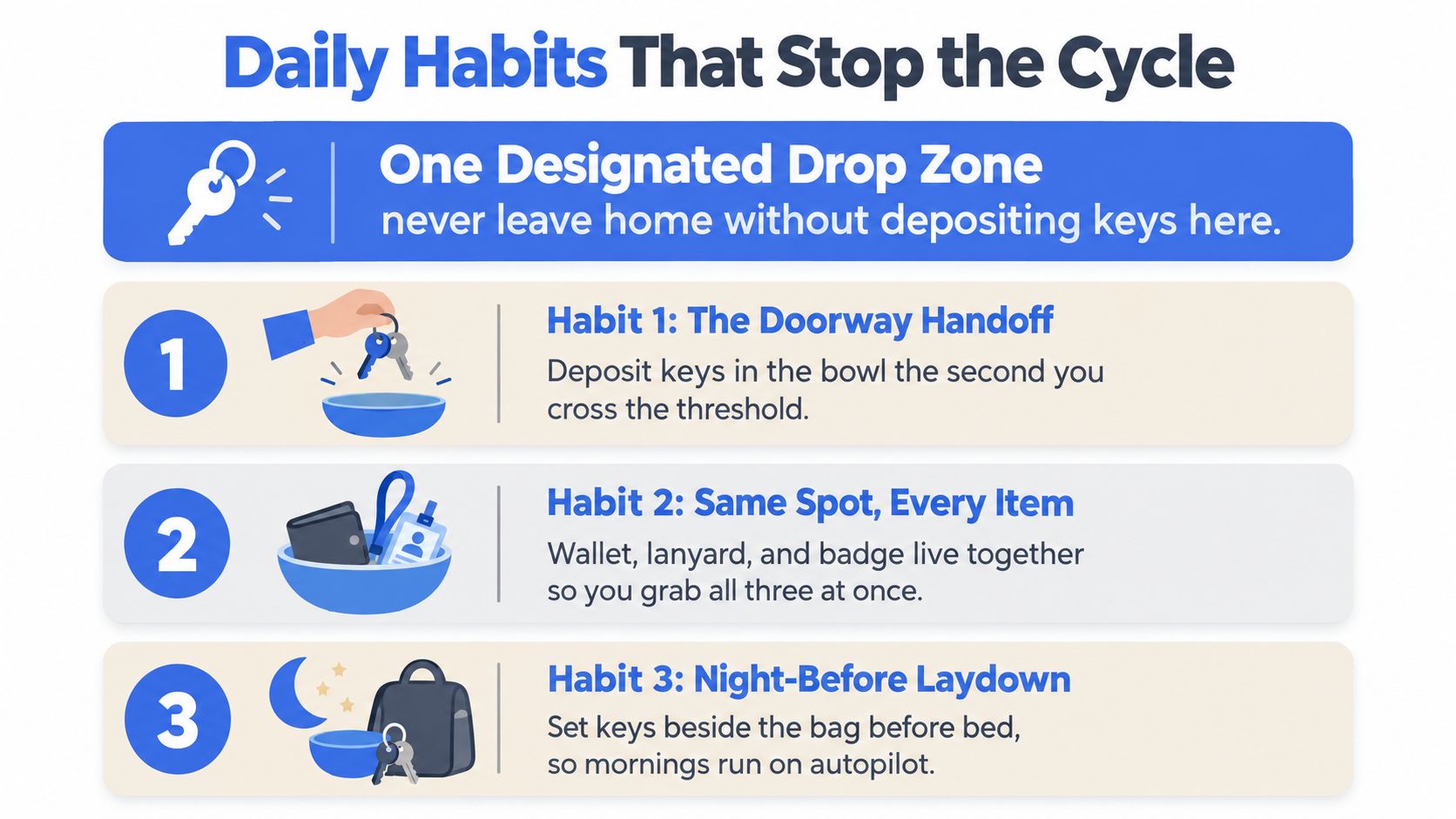
The most effective prevention system has one physical rule: keys have one home. Use a hook, bowl, or tray by the entrance, and make every other surface temporary at best.
Make the handoff automatic
The moment you cross the threshold, deposit the keys. Don’t put them down “for a second” while removing shoes or carrying packages. If your hands are full, place the keys in the designated spot before handling anything else, or keep the drop zone close enough to reach without crossing the room.
Pair the action with a small sound check. Before leaving a room, touch the key ring or listen for it in your pocket. That two-second pause catches the empty-pocket problem before you reach the door.
- Keep related items together: Store your wallet, badge, lanyard, and keys in one visible area when you’re at home.
- Use a night-before laydown: Put the keys beside tomorrow’s bag before bed, especially when the morning starts early.
- Protect the landing zone: Remove receipts, mail, and clutter from the bowl or tray so the keys remain visible.
- Review the system weekly: Walk through the house, confirm the drop zone is clear, and check that the ring, spare, and tracker are still attached.
The tracker supports this system, but it doesn’t replace it. A dead battery, forgotten phone, or misplaced tagged ring can put you back where you started. If someone else may need to know that you arrived safely or has to coordinate a late return, a live location sharing tool can address that separate communication need, but it won’t tell you where an untagged key is.
The goal isn’t perfect memory. It’s an environment that makes the right placement easier than the wrong one.
When Key Loss Tends to Spike
Keys go missing more often when routines become unfamiliar. Seasonal changes, travel, household disruption, and multitasking all create extra handoffs where the normal placement habit can fail.
Watch the transition points
Spring cleaning can move bowls, hooks, and furniture out of their usual positions. Holiday travel changes which bag and coat you use. Back-to-school periods crowd the entryway with extra shoes, backpacks, and paperwork. A move to a new home removes the muscle memory that once guided your hand to the familiar hook.
Hosting creates a different problem. A guest may move keys from a visible table to a safer-looking drawer, or you may relocate them while clearing space. Illness, young children, and pets can disrupt the sequence further. A child may treat the key ring as a toy, while a pet can push it beneath furniture or into another room.
Weather adds its own complications. Rain sends keys into a jacket pocket that isn’t normally used, while gloves make it awkward to place them on a hook. Carrying groceries, answering a call while getting in, or rushing between the car and the door divides attention at exactly the moment you need a consistent handoff.
UK data supports the idea that key problems affect everyday departures. MoneySuperMarket reported that 26% of drivers had been unable to find their keys before leaving the house, with commonly reported locations including clothes pockets, cars, couches, refrigerators, and keyholes, as described in its car key report.
The disruption can be costly as well as annoying. RAC reported that 43% of UK motorists, about 16 million drivers, regularly forgot where they left their car keys, spending an average of 2 minutes 10 seconds a day searching, or almost 14 hours a year. The same report said one in 20 drivers had lost car keys permanently, and 54% of those who replaced them paid an average of £176.20, according to RAC’s lost car key report.
Before a high-risk window, create a temporary drop zone, say “keys go here” as you place them, and verify the ring before walking away. That small verbal cue is especially useful when your normal hook, bag, or route has changed.
3rd-i offers live video, audio, and location sharing with selected contacts and trained Safety Agents, plus SOS support and emergency escalation through RapidSOS for situations such as late walks, rideshares, and lone working. If you want real-time oversight for yourself, your family, campus community, or team, visit 3rd-i to explore the app and monitoring options.